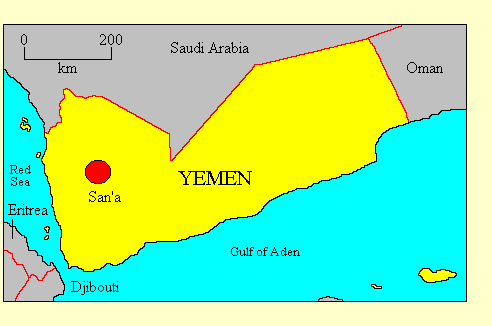
REPUBLIC OF YEMEN
• Official name: Al Jumhuriyah al-Yamaniyah (Republic of Yemen)
• Location: West Asia
• International organisations: Arab League, Non-Aligned Movement, Organisation of Islamic
Conference, United Nations
• Borders: Oman, Saudi Arabia
• Coastline: Arabian Sea, Red Sea
• Land area: 527,970 Km2
• Population: 23,600,000
• Annual GDP (PPP) per capita: US$2,500 (2009 CIA estimate). World ranking: 143
• Ethnicity: The population is almost entirely Arab, although many Yemenis are of part-African descent.
• Languages: Arabic is the official language and is universally used.
• Religion: Islam is the state religion. Almost the entire population are Sunni Moslems.
• Form of government: Officially, a presidential democratic republic. An practice, an authoritarian regime with some cosmetic reforms. Yemen consists of 17 governorates.
• Capital: Sanaa
• Constitution: The Constitution of the Republic of Yemen came into effect on 16 May 1991. It was substantially amended in 1994 to create a presidential system of government.
• Head of state: The President, elected by direct universal suffrage for a seven-year term. At the time of the last presidential election in 1999 the presidential term was five years. Its extension to seven years was approved by a referendum in 2001.
• Head of government: The Prime Minister, appointed by the President and in practice accountable to him.
• Legislature: Yemen has a bicameral legislature. The Assembly of Representatives (Majlis al-Nuwaab) has 301
members, elected for six-year terms from single-member constituencies. In 2001 an upper house, the Shura Council, was created, with 111 members appointed by the president.
• Electoral authority: Elections are conducted by the government.
• Freedom House 2011 rating: Political Rights 6, Civil Liberties 5
• Transparency International Corruption Index: 22% (146 of 178 countries rated)
• Reporters Without Borders Press Freedom 2010 Index: 17.9% (170 of 178 countries rated)
• Heritage Foundation Economic Freedom 2010 Index: 54.2% (127 of 179 countries rated)
Political history
Yemen was an independent Imamate from ancient times, but from the 18th century it acknowledged a nominal
allegiance to the Ottoman Sultan. In 1872 the Ottomans made this a real sovereignty by occupying the country,
and annexing it outright in 1905. In 1839 the British occupied the port of Aden as a coaling station, and in
1873 they formally established the Aden Protectorate by agreement with the Ottomans. The rest of Yemen (commonly
called North Yemen) became an independent kingdom in 1918.
In the 1960s there was violent conflict in both parts of Yemen. In the north a republican revolt
fostered by Egypt led to civil war and the eventual overthrow of the monarchy: the Republic of Yemen was
established in 1962. At the same time the British were faced with an insurrection in the south, which led in
1967 to the independence of the People's Democratic Republic of Yemen under the Marxist Front for the
Liberation of Occupied South Yemen (FLOSY). Both countries were authoritarian regimes.
In 1990 the collapse of Communism led to the reunification of the two halves of Yemen under President
Ali Abdullah Saleh, who had been President of North Yemen since 1978. When the south Yemenis changed their minds in 1993,
there was a brief civil war in which the south was crushed. Saleh then introduced a new constitution which
concentrated power in his own hands behind a facade of democratic government.
In 1999 there was a presidential election in which Saleh polled 96% of the vote after the opposition
party candidate was barred and the only "opposition" candidate to Saleh was a member of his own party. Although
opposition parties were in theory tolerated, the media was tightly controlled and no serious opposition was permitted.
There was a slightly more competitive presidential election in 2006, but in practice President Saleh's
rule remained unchallenged until 2011.
The dominant political party in Yemen until 2011 was President Saleh's
General People's Congress (GPC). The
only significant opposition parties were the Islamist
Yemeni Congregation for Reform (Islah), the
Yemeni Socialist Party and the
extreme left-wing
Nasserite Unionist People's Organisation. Since the 2011 rising, the
National Council for the Forces of the Peaceful Revolution has been the umbrella opopsition organisation.
The 2011 "Arab Spring" saw a prolonged series of riots in Sanaa and other cities, but Saleh stubbornly refused
to depart, despite pressure from western and other Arab governments. In June he was severely injured in an asassination
attempt, but after treatment in Saudi Arabia he returned, provoking fresh rioting. Finally in November he agreed to
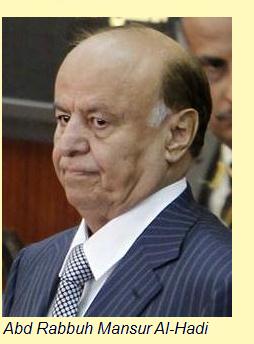
step down. Under the terms of the agreement, presidential elections were held in February 2012 at which Vice-President
Abd Rabbuh Mansur Al-Hadi was elected unopposed.
Legislative elections are promised for later in 2012.
Freedom House's 2011
report on Yemen
(which was written before the upheavals of 2011) says: "Yemen is not an electoral democracy. The political system is
dominated by the ruling GPC party, and there are few limits on the authority of the executive branch. President Ali
Abdullah Saleh has been serving continuously since 1978, when he became president of North Yemen through a military
coup... Past elections have been marred by the abuse of state resources, voter registration irregularities, and other
flaws. Corruption is an endemic problem. Despite some recent efforts by the government to fight graft, Yemen lacks
most legal safeguards against conflicts of interest... The state maintains a monopoly over the media that reach the
most people: television and radio... The constitution states that Islam is the official religion and declares Sharia
(Islamic law) to be the source of all legislation... Yemenis enjoy some freedom of assembly, with periodic restrictions
and sometimes deadly interventions by the government... Yemenis have the right to form associations under Article 58
of the constitution, and several thousand non-governmental organisations operate in the country...
The judiciary is nominally independent, but in practice it is susceptible to interference from the executive branch...
Security forces affiliated with the Political Security Office (PSO) and the Ministry of the Interior torture and abuse detainees."
Updated March 2012
|