SOCIALIST REPUBLIC
OF VIETNAM
• Official name: Cong Hoa Xa Hoi Chu Nghia Viet Nam (Socialist Republic of Vietnam)
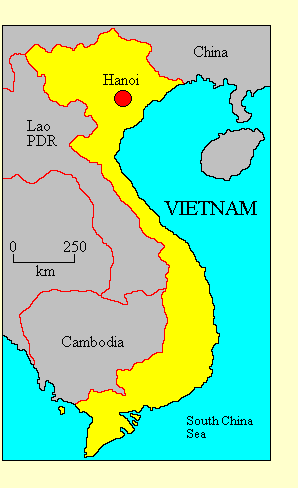
• Location: South East Asia
• International organisations: Association of South East Asian Nations, Non-Aligned Movement,
Organisation Internationale de la Francophonie, United Nations
• Borders: Cambodia, China, Lao PDR
• Coastline: South China Sea, Gulf of Thailand, Tonkin Gulf
• Land area: 329,560 Km2
• Population: 85,800,000
• Annual GDP (PPP) per capita: US$2,900 (2009 CIA estimate). World ranking: 135
• Ethnicity: Over 90% of the people are Vietnamese. There are
small Chinese, Thai, Khmer and other minority communities.
• Languages: Vietnamese is the official language. French, English and
Chinese are used in urban areas.
• Religion: Vietnam is officially an atheist country, but the majority
of the population are Buddhists or follow one of the local variants
such as Hoa Hao ar Cao Dai. There is a substantial Catholic Christian
minority.
• Form of government: People's republic (in practice, a Communist
dictatorship). Vietnam is divided into 58 provinces and three
municipalities.
• Capital: Hanoi
• Constitution: The Constitution
of the Socialist Republic of Vietnam
came into effect on 15 April 1992.
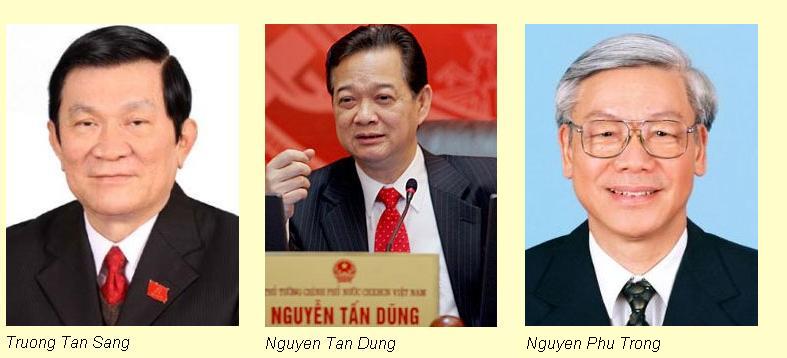
• Head of state: The President, elected by the National Assembly
from among its members for a five-year term. The President's functions are largely ceremonial. President
Truong Tan Sang took office on 25 July 2011.
• Head of government: The Prime Minister, appointed by the President. The current Prime Minister,
Nguyen Tan Dung, has been in office since June 2006.
• Legislature: The National Assembly
(Quoc-Hoi) is a unicameral
legislature with 493 members who serve five-year terms. Only candidates
who are members of or approved by the Communist Party can stand for
election. The last such election was held on 20 May 2007.
• Electoral authority: Elections are conducted by the government.
• Freedom House 2011 rating: Political Rights 7, Civil Liberties 5
• Transparency International Corruption Index: 27% (116 of 178 countries rated)
• Reporters Without Borders Press Freedom 2010 Index: 24.2% (165 of 178 countries rated)
• Heritage Foundation Economic Freedom 2010 Index: 51.6% (139 of 178 countries rated)
Political history
The three Vietnamese kingdoms of Annam, Cochin and Tonkin were brought under
French control between 1862 and 1883. French Indochina was occupied by Japan in
1940, and following the Japanese surrender in 1945 the Communist-controlled
nationalist movement declared Vietnam's independence. When the French attempted
to reassert control, war broke out and
the French were defeated in 1954. Ho Chi Minh then became ruler of a Communist state
in the north, while a weak anti-Communist regime was established in the south under
American protection.
Communist attempts to take power in the South led to the Vietnam War, which
raged from 1964 to 1975, at one time engaging 500,000 American troops. Under
President Nguyen Van Thieu (1965-75) presidential and legislative elections were held in the
south, but Thieu's regime was essentially an authoriarian one, though allowance must
be made for the fact that it was under constant Communist armed attack. The Americans
withdrew following the Paris Peace Accords of 1973, and in 1975 Saigon fell to the
invading North Vietnamese army.
Since then the Communist Party of Vietnam
has ruled the country and no opposition has been permitted. Over the past 20 years there
has been a half-hearted economic reform, which has led to faster economic growth, but no concessions in the
political system. The current Party leader, Nguyen Phu Trong,
assumed his post in January 2011.
Freedom House's 2011 report on Vietnam
says: "Vietnam is not an electoral democracy. Vietnam is not an electoral democracy.The CPV, the sole legal political party,
controls politics and the government, and its Central Committee is the top decision-making body. The National Assembly...
generally follows CPV dictates... Corruption and abuse of office are serious problems. Although senior CPV and government
officials have acknowledged growing public discontent, they have mainly responded with a few high-profile prosecutions of
corrupt officials and private individuals rather than comprehensive reforms... The government tightly controls the media,
silencing critics through the courts and other means of harassment... Religious freedom remains restricted...
Academic freedom is limited... Freedoms of association and assembly are restricted... Vietnam’s judiciary is subservient to
the CPV, which controls courts at all levels."
Updated November 2011
|