UKRAINE
• Official name: Ukraina (Ukraine)
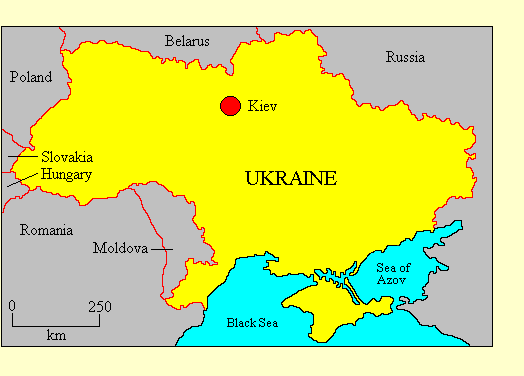
• Location: Eastern Europe
• International organisations: Commonwealth of Independent States, Council of Europe,
Organisation for Security and Co-operation in Europe, United Nations, World Trade Organisation
• Borders: Belarus, Hungary, Moldova, Poland, Romania, Russia, Slovakia
• Coastline: Black Sea
• Land area: 603,700 Km2
• Population: 46,000,000 (Ukraine's population is declining by 150,000 a year.)
• Annual GDP (PPP) per capita: US$6,400 (2009 CIA estimate). World ranking: 104
• Ethnicity: Ukrainian 73%, Russian 22%. Russians and Ukrainians are ethnically identical, the
difference is purely linguistic.
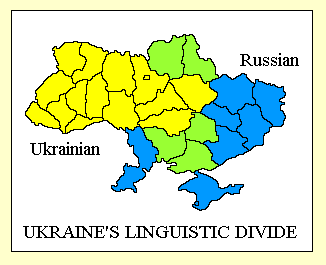
• Languages: Ukrainian is the national language but only 62% speak it as their first
language. Russian is widely used, and 22% speak it as their first language, mainly in Crimea and the
eastern third of the
country. Minorities speak Polish (2.2%), Belarusian (1%), Yiddish (1%), Romanian
and Hungarian.
• Religion: The large majority is at least nominally Orthodox Christian, although the level of
religious practice in urban areas is very low.
Ukrainian Orthodox are divided into three factions, one affiliated with the Orthodox Church
in Russia, and two which claim to be independent of it. There is a large minority (8%) of
Ukrainian Catholics, known as Uniates, and a small (1%) Jewish minority.
• Form of government: Presidential democratic republic. Ukraine is divided into 24 oblasts
(districts) and two municipalities. The Crimea is an Autonomous Republic.
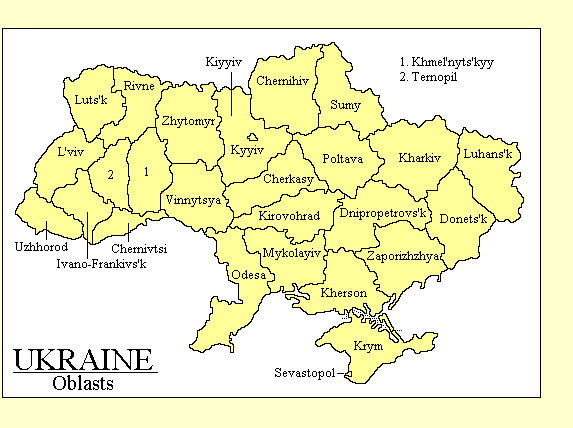
• Capital: Kiev (Kyyiv)
• Constitution: The Constitution of Ukraine came into effect on 28 June 1996
• Head of state: The President, elected by direct universal suffrage for a five-year term. The Constitution makes the President the effective head of the government.
• Head of government: The Prime Minister, appointed by the President. The Prime Minister is in theory accountable to the legislature, but the weakness of that body means that the Prime Minister holds office at the pleasure of the President.
• Legislature: The Supreme Council (Verkhovna
Rada) is a unicameral legislature. It has 450 members, elected for four-year terms by proportional representation from national party lists.
• Electoral authority: The Ukrainian Central Election Commission controls national elections.
• Freedom House 2011 rating: Political Rights 3, Civil Liberties 3
• Transparency International Corruption Index: 24% (134 of 178 countries rated)
• Reporters Without Borders Press Freedom 2010 Index: 53.2% (131 of 178 countries rated)
• Heritage Foundation Economic Freedom 2010 Index: 45.8% (164 of 178 countries rated)
Political history
"Ukraine" means "borderland" in the East Slavic languages, and Ukraine was for centuries the
borderland between the Russian homelands and the Ottoman Empire to the south. As the Ottomans withdrew,
Ukraine was absorbed into the Russian Empire. Although there are some differences between the Russian
and Ukrainian languages, only in the 19th century did a sense of a separate Ukrainian nationality
emerge.
The collapse of the Russian Empire in 1918 enabled Ukrainian nationalists to seize power in Kiev and
declare Ukrainian independence under German protection. But with the withdrawal of the Germans the
Russian Bolsheviks emerged victorious in the ensuing civil war, and in 1921 Ukraine became a republic
of the Soviet Union. The Communist regime always suspected Ukraine of separatist tendencies, and the
famines and purges of the Stalin era hit Ukraine particularly hard. Ukraine was occupied by the
Germans from 1941 to 1944, but the Nazis saw Ukraine simply as a resource to be looted and did not
allow Ukrainian nationalists to organise.
The decline of Soviet power in 1990 saw Ukrainian nationalism re-emerge, and Ukraine became
independent with the end of the Soviet Union in 1991. Unfortunately the Soviet-era boundaries included
large areas which are almost entirely Russian within the Ukrainian state, a source of instability and
discontent. Only in the west of the country does the majority of the population speak Ukrainian. Ukraine has inherited many Soviet institutions and attitudes along with the decaying
industries of the Donbass. Government has been authoritarian, corrupt and incompetent, economic
reform has been slow, and vital issues such as land privatisation and the environment remain
untackled. Since independence living standards and population have fallen.
President Leonid Kuchma's corruption-ridden term expired in 2004, and the pro-Russian faction tried to instal
Prime Minister Viktor Yanukovych as his successor. Allegations of vote rigging in the second round in
November led to a prolonged political crisis, dubbed the "Orange Revolution." A rerun of the election
in December gave the reformist candidate, Viktor Yushchenko, a majority.
The campaign was notable for an attempt
by Russian agents to poison Yushchenko with dioxin, which has left him permanently disfigured.

At legislative elections in March 2006, Yushchenko's party suffered heavy losses to the party of
his former Prime Minister and ally, Yulia Timoshenko. Fresh elections were held in 2007, after
which three
large groupings dominated the legislature. The
Party of the Regions (PR) of former Prime
Minister Viktor Yanukovych represents the
Russian-speaking industrial areas in the east, and is widely seen as an agent of the Russian government,
which has never accepted Ukrainian independence. The declining
Communist Party of Ukraine (KPY) is allied with the Party of
the Regions. The
Yulia Timoshenko Bloc (BYT) is a Ukrainian nationalist party and is
the largest party in western Ukraine. The
Our Ukraine Bloc (BNY) of President Viktor Yushchenko is
also based in western Ukraine.
Yushchenko and Timoshenko became allies of necessity against the
pro-Russian
forces (which are backed by the increasingly belligerent Putin regime in Russia) while remaining bitter
personal rivals. Timoshenko was Yushchenko's first Prime Minister in 2005, but
resigned after less than a year. Her party was the biggest winner at the 2007 elections, and
she again became Prime Minister. After further conflicts between the two, Yushchenko tried to call
fresh elections in 2008, but was blocked by the legislature's refusal to approve the necessary funds.
In December 2008 the two rivals again reached an agreement to work together. At the 2010 presidential
elections, Tymoshenko knocked Yushchenko out in the first round, but was defeated by
Viktor Yanukovych in the second round
in February. Yanukovych took office in March and appointed
Mykola (Nikolai) Azarov, a Russian, as Prime
Minister. Yanukovych's victory was followed by a slide towards authoritarian government, culminating in the
imprisonment in September 2011 of former Prime Minister Yulia Timoshenko. By 2011 it was clear that both
Ukrainian democracy and national sovereignty were at risk under Yunukovych's authoritarian and pro-Russian regime.
Freedom House's 2011
report on Ukraine
says: "Ukraine is an electoral democracy at the national level, with the opposition winning in the four
most recent presidential and parliamentary elections. However, the October 31, 2010, local elections showed serious
flaws under newly elected president Viktor Yanukovych's leadership... Corruption remains one of the country's most
serious problems. Business magnates are presumed to benefit financially from their close association with top
politicians, while the party-list electoral system reinforces legislators’ loyalty to party bosses and leaves them
less accountable to voters... The constitution guarantees freedoms of speech and expression [but] conditions worsened
after Yanukovych's election... Academic freedom has come under pressure since Yanukovych took power...
The constitution guarantees the right to peaceful assembly but Yanukovych's government has made it more difficult to
assemble... Ukraine has one of the most vibrant civil societies in the region. However, the SBU has begun to pressure
foreign-funded nongovernmental organizations (NGOs)... The judiciary is subject to intense political pressure. Under the
previous administration, the judiciary was an important arbiter in the political battles between the president and prime
minister, and all political factions attempted to manipulate courts, judges, and legal procedures. The Constitutional
Court had largely remained silent in the face of politicians’ attempts to grab power. Under Yanukovych, however, the
Constitutional Court has sided with the president, allowing him to form a parliamentary majority and overturn the 2004
constitutional amendments."
Updated November 2011
|