REPUBLIC OF TURKMENISTAN
• Official name: Turkmenistan Jumhuriyati (Republic of Turkmenistan)
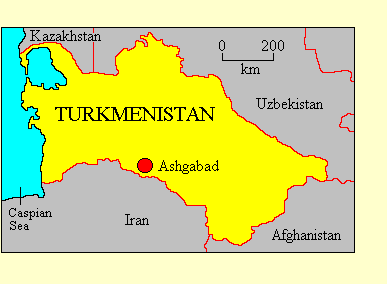
• Location: Central Asia
• International organisations: Commonwealth of Independent States, Non-Aligned Movement, Organisation of
Islamic Conference, Organisation for Security and Co-operation in Europe, United Nations
• Borders: Afghanistan, Iran, Kazakhstan, Uzbekistan
• Coastline: None (Turkmenistan has a coastline on the Caspian Sea but this does
not give access to the sea.)
• Land area: 488,100 Km2
• Population: 5,100,000
• Annual GDP (PPP) per capita: US$6,900 (2009 CIA estimate). World ranking: 101
• Ethnicity: Turkmen 77%, Uzbek 9.2%, Russian 6.7%, Kazakh 2%
• Languages: Turkmen is the official language and is spoken by about 75%
of the population. Russian is the first language of 12% and is widely used in
business and communications. Uzbek (9%) is the largest minority language.
• Religion: Sunni Moslem 89%, Orthodox Christian 9%. Religious practice is
discouraged by the government.
• Form of government: Dictatorship. Turkmenistan is divided into five provinces.
• Capital: Ashgabat
• Constitution: The new
Constitution of Turkmenistan came into effect on 26 September 2008.
• Head of state: The President, elected by the people for a five-year term. In practice no opposition to the
president's candidacy is permitted.
• Head of government: The President, who appoints all ministers.
• Legislature: Turkmenistan has a unicameral legislature. The Assembly (Mejlis)
has 150 members, elected for five-year terms from single-seat
constituencies. In practice, the legislature consists entirely of members of the President's party and its
functions are purely decorative.
• Electoral authority: None
• Freedom House 2009 rating: Political Rights 7, Civil Liberties 7
(Freedom House lists Turkmenistan as one of the world's worst seven regimes for
both political rights and civil liberties.)
Political history
The Turkmen-speaking lands were under the sovereignty of the Khanate of Khiva
until the late 19th century, when the Russians penetrated the area. Turkmen
resistance ended in 1881 with the battle of Dengil-Tepe. In 1899
Turkmenistan became part of the governate-general of Russian Turkistan. A period
of disorder following the collapse of the Russian Empire ended with
communist occupation in 1919. In 1924 the area became the Turkistan Autonomous
Soviet Socialist Republic, and in 1936 the Turkmen Soviet Socialist Republic.
The was little pressure for independence in Turkmenistan until the collapse
of the Soviet Union in 1991, when a declaration of independence was passed.
The Turkmen Communist boss Saparmurad Niyazov became president and
soon established a Soviet-style dictatorship. He was re-elected unopposed in 1992
and in 1999 the legislature declared him President for Life with the title Turkmenbashi (Father of the
Turkmens). The Democratic Party (the renamed Communist Party) was the only legal party, and all opposition was
suppressed.
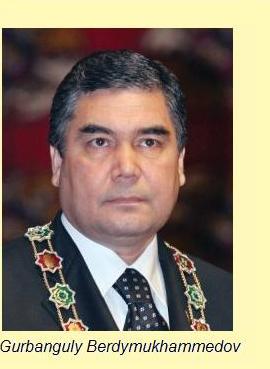
Niyazov died in 2006 and his successor
Gurbanguly Berdymukhammedov dismantled
Niyazov's personal dictatorship, passing a new constitution in 2008 which in theory restored an elected
presidency and legislature and authorised the formation of political parties. In practice however, no
serious opposition to the regime is permitted, and Berdymukhammedov was elected in 2007 against only token
opposition.
Freedom House's 2009
report on Turkmenistan
says: "Turkmenistan is not an electoral democracy... None of the country's elections, including the
February 2007 vote that gave Gurbanguly Berdymukhammedov a five-year term in office, has been free or fair...
Corruption is widespread, with public officials often forced to bribe their way into their positions...
Turkmenistan was ranked 166 out of 180 countries surveyed in Transparency International's 2008 Corruption
Perceptions Index... Freedom of speech and the press is severely restricted by the government, which controls
all broadcast and print media... The constitution guarantees peaceful assembly and association, but these
rights are severely restricted in practice... The judicial system is subservient to the president, who
appoints and removes judges without legislative review."
Updated January 2010
|