REPUBLIC OF TAJIKISTAN
• Official name: Jumhurii Tajikistan (Republic of Tajikistan)
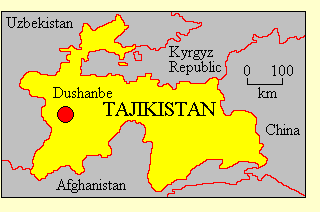
• Location: Central Asia
• International organisations: Commonwealth of Independent States, Organisation for Security and
Co-operation in Europe, United Nations
• Borders: Afghanistan, China, Kyrgyz Republic, Uzbekistan
• Coastline: None
• Land area: 143,100 Km2
• Population: 7,300,000
• Annual GDP (PPP) per capita: US$1,800 (2009 CIA estimate). World ranking: 156
• Ethnicity: Tajik 64.9%, Uzbek 25%, Russian 3.5%
• Languages: is the official language
• Religion: Sunni Moslem 85%, Shi'a Moslem 5%. There is a small Orthodox Christian minority.
• Form of government: Presidential republic. Tajikistan is divided into four provinces.
• Capital: Dushanbe
• Constitution: The
Constitution of the Republic of Tajikistan came into effect on 6 November 1994.
• Head of state: The President, elected by direct universal suffrage for a seven-year term.
• Head of government: The Prime Minister, appointed by the President.
• Legislature: Tajikistan has a bicameral legislature, the Parliament (Majlisi Oli).
The Assembly of Representatives (Majlisi Mamoyandogan) has
63 members, elected for five-year terms. 41 members are elected from single-member constituencies and
22 by proportional representation. The
National Assembly (Majlisi Milliy) has 33 members,
25 elected for five-year terms by local government representatives and eight appointed by the president.
• Electoral authority: The Central Election Commission administers national elections. It has no
website.
• Freedom House 2009 rating: Political Rights 6, Civil Liberties 5
Political history
The Tajik-speaking lands were incorporated into the Russian Empire in 1895. When the
Russian Empire collapsed in 1917 the Tajiks tried to reclaim their independence, but the
Russian Communists gained control in 1921 and Tajikistan was incorporated into Soviet
Uzbekistan. Tajikistan became a separate republic of the Soviet Union in 1929.

When the Soviet Union disintegrated in 1991 Tajikistan declared its independence.
Attempts to establish a democratic system were thwarted by the Communist Party aparatus,
which installed former party boss Rakhman Nabiyev as President. In 1992 he was driven
out by an Islamic rebellion, and a brief but bloody civil war followed. In November 1992
the Communists regained control and chose
Emomalii Rahmon (formerly known by the
Russified form of his name, Rakhmanov) as President. Fighting
between government troops, supported by the Russian army, and Islamic forces persisted along the
Afghanistan border, but in 1994 a cease-fire was signed.
Rahmon's regime is essentially the Soviet system of one-party rule with a thin
veneer of democratic reform. Rahmon was elected President in 1999 and 2006, but democratic parties
boycotted these elections. Rahmon's People's Democratic Party of Tajikistan is the dominant party,
allied with the Communist Party of Tajikistan. At legislative elections in 2005 and 2010, the
ruling party won nearly all the seats. These elections are generally views as rigged. The only
significant opposition party is the Islamic Renaissance of Tajikistan, an islamist party
Freedom House's 2009
report on Tajikistan
says: "Tajikistan is not an electoral democracy... Elections are neither free nor fair. Patronage
networks and regional affiliations are central to political life, with officials from the president's
native Kulyob region dominant in government... Corruption is reportedly pervasive... Members of the
president's family allegedly maintain extensive business interests. Tajikistan was ranked 151 out of
180 countries surveyed in Transparency International's 2008 Corruption Perceptions Index... Despite
constitutional guarantees of freedom of speech and the press, independent journalists face harassment
and intimidation... The government at times limits freedoms of assembly and association... The
judiciary lacks independence. Many judges are poorly trained and inexperienced, and bribery is
reportedly widespread."
Updated June 2010
|