ARAB REPUBLIC
OF SYRIA
• Official name: Al Jumhuriyah al-Arabiyah as-Suriyah (Arab Republic of Syria)
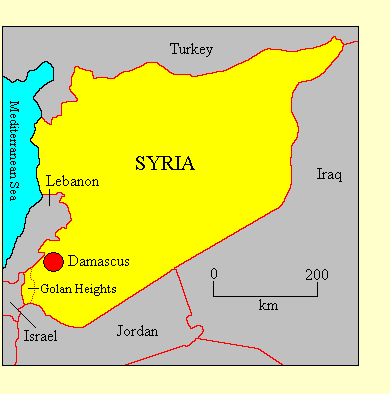
• Location: West Asia
• International organisations: Arab League, Non-Aligned Movement, Organisation of Islamic Conference,
United Nations
• Borders: Iraq, Israel, Jordan, Lebanon, Turkey
• Coastline: Mediterranean Sea
• Land area: 185,100 Km2 (including Golan Heights)
• Population: 21,900,000
• Annual GDP (PPP) per capita: US$4,600 (2009 CIA estimate). World ranking: 119
• Ethnicity: Over 90% of the population are Arabs. There is a 7% Kurdish minority
and a small minority of Armenians.
• Languages: Arabic is the official language and is universally used except in the Kurdish areas.
• Religion: Islam is the state religion. 74% of the population are Sunni Moslems,
16% belong to sects such as the Alawites and Druze, and 10% belong to various
Christian denominations.
• Form of government: In form, a presidential republic. In fact, an absolute
dictatorship. Syria is divided into 14 provinces.
• Capital: Damascus (al-Dimashq)
• Constitution: The Syrian
Constitution came into effect on 13 March 1973.
• Head of state: The President, in theory elected by direct universal suffrage for
a seven-year term. In practice the al-Assad family have ruled as absolute dictators since 1970.
• Head of government: The Prime Minister, appointed by the President.
• Legislature: Syria has a unicameral legislature, the
People's Assembly (Majlis al-Sha'ab),
which has 250 members elected for four-year terms in 15 multi-seat constituencies. No
candidates who are not supporters of the government are permitted and in any case the
legislature is purely decorative.
• Electoral authority: Elections are conducted by the government.
• Freedom House 2011 rating: Political Rights 7, Civil Liberties 6
• Transparency International Corruption Index: 25% (127 of 178 countries rated)
• Reporters Without Borders Press Freedom 2010 Index: 8.5% (173 of 178 countries rated)
• Heritage Foundation Economic Freedom 2010 Index: 51.3% (140 of 178 countries rated)
Political history
Syria was a province of the Ottoman Empire from 1516 until World War I, when
it was occupied by British troops. The League of Nations assigned Syria to the
French as a mandated territory, and the French detached Lebanon, with its large Christian population.
Arab nationalists revolted against French rule in 1925 but were defeated. In 1936 the French granted
Syria self-government, but this agreement soon collapsed since the Arabs demanded independence.

In 1941 British and Free French troops evicted the Vichy French from Syria,
and de Gaulle promised the Syrians independence after the war. Syria became fully
independent in April 1946. The French left behind a parliamentary system, but this was
overthrown in 1949 by the first of several military coups. Civilian government was restored and elections
held in 1954. In 1957 Syria
agreed to merge with Egypt in the United Arab Republic. But Syrian resentment at
Egyptian domination soon grew, and in 1963 another military coup, led by supporters
of the Ba'ath Socialist Party, brought this experiment to an end.
In 1970 a further coup brought Hafez al-Assad to power, and he established
one of the world's most durable dictatorships, holding power until his death in 2000
and being succeeded by his son
Bashir al-Assad without overt opposition. The
Assads belong to the minority Alawite sect of Shi'a Islam and can only hold power in Sunni Syria by means of
ruthless dictatorship. There was some liberalisation early in Bashir al-Assad's rule, but after riots and
protests in 2004 and 2005, there was a wave of severe repression which crushed most opposition. Following the
"Arab Spring" in Egypt in early 2011, riots and rebellions broke out in cities across Syria, which the regime
tried to repress by force. By November over 3,000 people had been killed but the rebellion had not been put down, and
in fact seemed to be escalating.
Freedom House's 2011
report on Syria
says: "Syria is not an electoral democracy. Under the 1973 constitution, the president is nominated by the ruling Baath
Party and approved by popular referendum for seven-year terms. In practice, these referendums are orchestrated by the
regime, as are elections for the 250-seat, unicameral People’s Council... Almost all power rests in the executive branch.
The only legal political parties are the Baath Party and its several small coalition partners in the ruling National
Progressive Front (NPF)... Corruption is widespread [and] regime officials and their families benefit from a range of
illicit economic activities... Freedom of expression is heavily restricted. Vaguely worded articles of the penal code, the
Emergency Law, and a 2001 Publications Law criminalise the publication of material that harms national unity, tarnishes
the image of the state, or threatens the "goals of the revolution"... Freedom of assembly is closely circumscribed.
Public demonstrations are illegal without official permission... While the lower courts operate with some independence
and generally safeguard defendants' rights, politically sensitive cases are usually tried by the Supreme State Security
Court (SSSC), an exceptional tribunal established under emergency law that denies the right to appeal, limits access to
legal counsel, tries many cases behind closed doors, and routinely accepts confessions obtained through torture...
The security agencies, which operate independently of the judiciary, routinely extract confessions by torturing suspects
and detaining their family members."
Updated November 2011
|