KINGDOM OF
SAUDI ARABIA
• Official name: Al Mamlakah al-Arabiyah as-Saudiyah (Kingdom of Saudi Arabia). The actual name of the
country is Arabia. The Saudis are its ruling family. People from the country should thus be called Arabians
rather than Saudis.
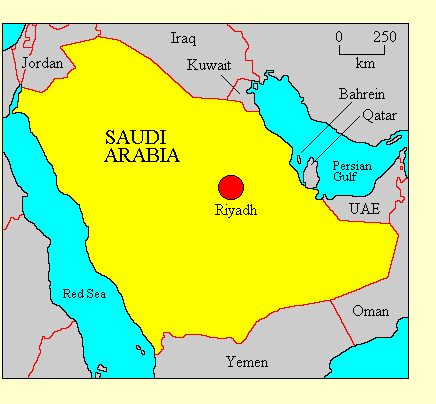
• Location: Middle East
• International organisations: Arab League, Group of Twenty, Non-Aligned Movement, Organisation of Islamic Conference,
Organisation of Petroleum Exporting Countries, United Nations
• Borders: Iraq, Jordan, Kuwait, Oman, Qatar, United Arab Emirates, Yemen
• Coastline: Persian Gulf, Red Sea
• Land area: 1,900,000 Km2
• Population: 26,900,000
• Annual GDP (PPP) per capita: US$20,400 (2009 CIA estimate). World ranking: 46
• Ethnicity: About 90% of the population are Arabs, although this includes many guests workers from other Arab countries. There is a long-resident minority of Black Africans, descendents of slaves. Minorities of workers from the Indian subcontinent and the Philippines are increasing.
• Languages: Arabic is the official language and is universally used.
• Religion: Islam is the state religion and the royal family take seriously their role as guardians of the
Islamic foundational sites of Mecca and Medina. Other religions are barely tolerated among guest workers but
not among Saudi Arabian nationals.
• Form of government: Absolute monarchy. Saudi Arabia is divided into 13 provinces.
• Capital: Riyadh
• Constitution: The Basic Law of Government, a
quasi-constitutional document, was issued by the King in 1993. This document states that "God's Book and the
Sunnah of His Prophet, God's prayers and peace be upon him, are [the country's] constitution."
• Head of state: King Abdullah bin Abdul Aziz Al Saud
succeeded to the throne on 1 August 2005.
• Head of government: The King, who appoints all ministers.
• Legislature: None
• Electoral authority: None
• Freedom House 2011 rating: Political Rights 7, Civil Liberties 6
• Transparency International Corruption Index: 53% (50 of 178 countries rated)
• Reporters Without Borders Press Freedom 2010 Index: 38.5% (1575 of 178 countries rated)
• Heritage Foundation Economic Freedom 2010 Index: 66.2% (54 of 178 countries rated)
Political history
Before the First World War the Arabian peninsula consisted of a group of emirates owing nominal alliegance
to the Ottoman Sultan but in practice independent. The most important of these was Hejaz on the Red Sea coast,
which controlled the religious and commercial centres of Mecca and Medina. The Emir of Hejaz, Hussein al-Hashemi,
was Britain's main ally in the area and led the Arab revolt against Ottoman rule.

In the conflicts which followed the war and the departure of the Ottomans, however, Hussein was defeated
by Abd-al-Aziz al-Saud (generally known as Ibn Saud), head of the al-Saud family and Emir of Nejd, a desert
emirate in the centre of the peninsula. Abd-al-Aziz declared himself King of Nejd and Hejaz in 1926, and in 1932
he united the two kingdoms and became King of Saudi Arabia.
The discovery of the world's largest reserves of oil transformed Saudi Arabia from a poor desert kingdom
into one of the world's greatest economic powers, and led to a rapid growth of population, including millions of
imported workers. But the al-Sauds refused to allow any change in the country's political system, and it has
remained an absolute monarchy. As followers of the Wahhabi sect, the al-Sauds also enforced rigid Islamic
orthodoxy.
Since Abd-al-Aziz's death in 1953 the Kingdom has been ruled by five of his many sons
in succession. King Abdullah succeeded in 2005 and in theory exercises absolute civil and religious authority. He
may take advice from an appointed Majlis. His heir and de facto prime minister is his half-brother, Prince
Sultan.
The al-Sauds are now a priviliged clan with thousands of members, monopolising political and economic
power. The rule that the succession must pass to one of the remaining sons of Abd-al-Aziz (he had 44 sons),
excluding younger members of the enormous royal family, is a source of great tension. As the remaining sons of
Abd-al-Aziz grow elderly, the monarchy has become increasingly feeble and unpopular.
Since the 1980s Saudi Arabia's population has doubled but its oil revenues have fallen sharply in real
terms, leading to a burgeoning economic and social crisis, since oil wealth has always provided a cushion
against political dissent. The close alignment of the royal family with the United States has also fuelled
opposition.
Freedom House's 2011
report on Saudi Arabia
says: "Saudi Arabia is not an electoral democracy... The 1992 Basic Law declares that the Koran and the Sunna
(the guidance set by the deeds and sayings of the prophet Muhammad) are the country's constitution. The cabinet,
which is appointed by the king, passes legislation that becomes law once ratified by royal decree. The king also
appoints a 150-member Majlis al-Shura (Consultative Council) every four years, though it serves only in an
advisory capacity... Political parties are forbidden, and organised political opposition exists only outside the country...
Corruption remains a significant problem... The government tightly controls domestic media content and dominates regional
print and satellite-television coverage, with members of the royal family owning major stakes in news outlets...
Islam is the official religion, and all Saudis are required by law to be Muslims. The government prohibits the public
practice of any religion other than Islam and restricts the religious practices of the Shi'ite and Sufi Muslim
minority sects... Academic freedom is restricted, and informers monitor classrooms for compliance with curriculum rules,
such as a ban on teaching secular philosophy and religions other than Islam... Freedoms of association and assembly
are not upheld... In 2007, Abdullah established a new Supreme Court and an Appeals Court, whose members are appointed by the
king... Women are not treated as equal members of society, and many laws discriminate against them."
Updated November 2011
|