
STATE OF QATAR
• Official name: Dawlat Qatar (State of Qatar)
• Location: Middle East
• International organisations: Arab League, Non-Aligned Movement, Organisation of Islamic Conference,
Organisation of Petroleum Exporting Countries, United Nations, World Trade Organisation
• Borders: None
• Coastline: Persian Gulf
• Land area: 11,437 Km2
• Population: 1,400,000
• Annual GDP (PPP) per capita: US$121,700 (2009 CIA estimate). World ranking: 2. On this ranking Qatar is the
second-wealthiest country in the world. This is because of its oil wealth, which is mostly appropriated by
the ruling family. The people of Qatar certainly do not have the world's second-highest standard of living.
• Ethnicity: Only about 40% of the population are Arabs, and only about 25% are native Qataris. About 15% are
Arabs from other countries. Nearly 20% are Pakistanis, 20% Indians (mostly Muslim), while about 10% are Iranians.
• Languages: Arabic is the official language and is spoken by the Arab population. Indian languages and Farsi
are widely spoken.
• Religion: Wahhabist Sunni Islam is the state religion, and the public practice of other religions is illegal.
Over 70% of the population are Sunni Muslims, and about 20% are Shi'a Muslims. There are small Hindu and
Christian minorities.
• Form of government: Monarchy
• Capital: Doha
• Constitution: The new
Constitution of Qatar came into effect in 2003.
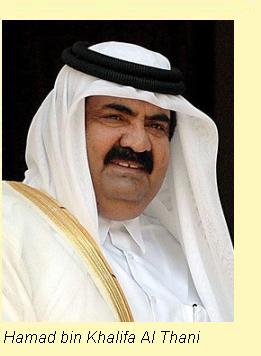
• Head of state: Emir Hamad bin Khalifa Al Thani came to the throne on 27 June 1995.
• Head of government: The Prime Minister, appointed by the Emir. The Prime Minister is the Emir's
brother and holds office at his pleasure.
• Legislature: Qatar has a unicameral legislature, the Advisory Council (Majlis al-Shura), which has 35 members
appointed by the Emir. The city of Doha, where the majority of Qataris live, has an elected city council.
• Electoral authority: None
• Freedom House rating: Political Rights 6, Civil Liberties 5
Political history
The Emirs of Qatar were tributaries of the Shah of Persia until Wahhabists from the interior of Arabia
took control in the late 18th century. The al-Thani family took power in about 1870, and accepted the nominal
sovereignty of the Ottoman Empire, at the same time signing a treaty that made them allies of the British.
In 1915 Ottoman sovereignty was terminated and the Emirate became a British protectorate. The discovery of
oil in 1940 made Qatar and its rulers wealthy, but also brought a flood of foreign workers who soon
outnumbered the native Qataris. The population of Qatar has doubled in the past 20 years, mainly because of
immigration.
Fear of the foreign majority is the dominant fact of Qatari politics. Unlike neighbouring Bahrein,
Qatar has made no moves towards liberalisation, for fear of arousing political aspirations among the
non-Qatari majority. The Emir and his family continue to make all decisions, and there are no plans to create
an elected legislature. The rule of the corrupt and despotic Khalifah ibn Hamad Al Thani was ended by a 1995
coup which brought his son Hamad ibn Khalifah Al Thani to power. Hamad is a more enlightened ruler than his
father. Qatar now has a constitution, and there has been some easing of repression, but Hamad remains disinclined
to share his power and wealth with anyone outside his own family.
Freedom House's 2009 report on Qatar
says: "Qatar is not an electoral democracy... Qatar was ranked 28 out of 180 countries surveyed in
Transparency International's 2008 Corruption Perceptions Index, making it the best performer in the Middle
East... The constitution guarantees freedom of expression. However, content in the print and broadcast media is influenced by
leading families, and journalists practice a high degree of self-censorship... While the constitution grants
freedom of assembly and the right to form organisations, these rights are limited in practice... Despite
constitutional guarantees, the judiciary is not independent in practice."
."
Updated June 2010
|