REPUBLIC OF PORTUGAL
• Official name: Republica Portuguesa (Republic of Portugal)
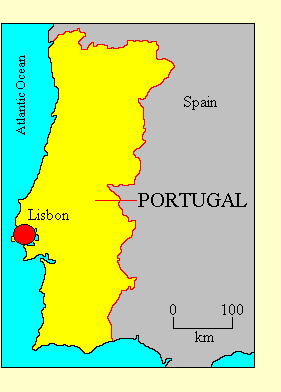
• Location: Western Europe
• International organisations: Council of Europe, European Union, North Atlantic Treaty Organisation,
Organisation for Economic Co-operation and Development, Organisation for Security and Co-operation in Europe,
United Nations, Western European Union, World Trade Organisation
• Borders: Spain
• Coastline: North Atlantic Ocean
• Land area: 92,391 Km2
• Population: 11,300,000
• Annual GDP (PPP) per capita: US$21,800 (2009 CIA estimate). World ranking: 43
• Ethnicity: Almost the entire population is of Portuguese stock. There is a small (1%)
minority of Africans from Portugal's former colonies.
• Languages: Portuguese is the official language and is univerally spoken.
• Religion: Over 90% of the population is at least nominally Catholic Christian.
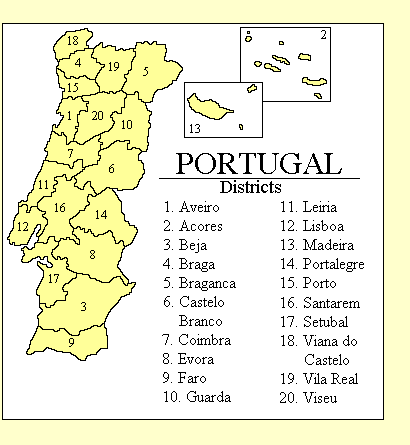
• Form of government: Parliamentary democratic republic. Portugal is divided into 18
districts, and two autonomous regions (the Azores and Madeira).
• Capital: Lisbon (Lisboa)
• Constitution: The Constitution of
the Republic of Portugal came into effect on 25 April 1976,
and has been amended several times since.
• Head of state: The President, elected by direct universal suffrage for a five-year
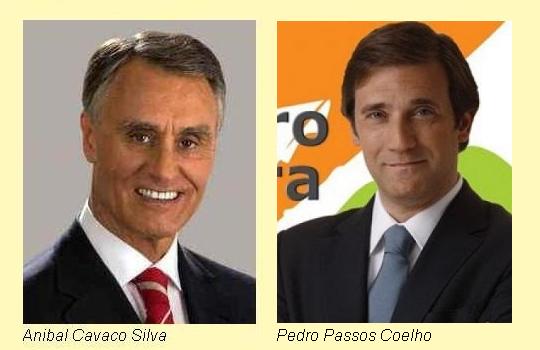
term. The President's functions are largely ceremonial. President
Anibal Cavaco Silva took
office on 9 March 2006.
• Head of government: The Prime Minister, appointed by the President. The Prime Minister
is the leader of the largest party in the legislature and is accountable to it.
• Legislature: Portugal has a unicameral legislature. The
Assembly of the Republic (Assembleia da Republica)
has 230 members, elected for four-year terms by proportional representation from
multi-member constituencies.
• Electoral authority: The National Election Commission
administers national elections.
• Freedom House 2009 rating: Political Rights 1, Civil Liberties 1
Political history
Portugal was an absolute monarchy until 1822, when King Joao VI was forced to accept
a consititution. For the rest of the 19th century there was bitter political conflict
between conservatives, liberals and radicals, verging at times on civil war. Constitutional
government survived, but in 1906 King Carlos gave dictatorial powers to Joao Franco, who
ruled without the support of the Cortes. Carlos was assassinated in 1908, and in 1910 a
republican revolution deposed his young successor Manoel II.
The republic was at first led by radicals, but resistance soon arose and the republic
became increasingly unstable. In 1926 the army seized
power and established an authoritarian regime, headed by Antonio Oscar de Fragoso Carmona. In
1932 Carmona appointed Antonio de Oliveira Salazar Prime Minister, and Salazar then ruled
Portugal for 36 years. He established a semi-fascist system called the New State,
supported by the Catholic Church. Salazar was succeeded in 1968 by Marcelo Caetano,
but the regime was undermined by the increasingly unpopular wars in Portugal's African
colonies.
In April 1974 the army again seized power, this time led by radicals who rapidly
established a democratic system. During 1974 and 1975 officers allied with the Communist
Party tried to gain control of the government, but the resistance of the democratic
parties prevented this, and in 1976 a moderate, Antonio dos Santos Ramalho Eanes, was
elected president. Since then Portugal has been a stable democracy.
The dominant party for most of the period since 1976 has been the
Socialist Party (PS), a moderate social-democratic
party. Also on the left, but without much of its former influence, is the hardline
Portuguese Communist Party (PCP), which is in a slightly unlikely
alliance with the The Greens. Even further to the left
is the radical Bloc of the Left (BE). In opposition are the centrist
Social Democrat Party (PSD), allied with the more conservative
Democratic and Social Centre – People's Party (CDS-PP).
The Socialist Jose Socrates Carvalho Pinto de Sousa became Prime Minister in 2005.
His government was re-elected to a second term in 2009. But the onset of the global financial crisis
in 2010 led to a debt crisis in Portugal which undermined the government's position. At the June 2011 election
the PSD and the CDS-PP had a comfortable victory, and the PSD leader
Pedro Passos Coelho formed a government.
Updated September 2011
|