REPUBLIC OF POLAND
• Official name: Rzeczpospolita Polska (Republic of Poland)
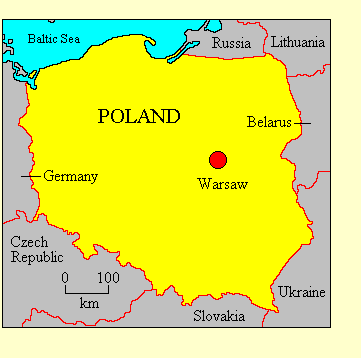
• Location: Eastern Europe
• International organisations: Council of Europe, European Union, North Atlantic Treaty Organisation,
Organisation for Economic Co-operation and Development, Organisation for Security and Co-operation in
Europe, United Nations, World Trade Organisation
• Borders: Belarus, Czech Republic, Germany, Lithuania, Russia, Slovakia, Ukraine
• Coastline: Baltic Sea
• Land area: 312,685 Km2
• Population: 38,100,000
• Annual GDP (PPP) per capita: US$17,900 (2009 CIA estimate). World ranking: 53
• Ethnicity: Polish 97.6%, German 1.3%, Ukrainian 0.6%, Belarusian 0.5%
• Languages: Polish is the official language and is universally understood.
• Religion: Catholic Christian 95%. Poland is one of the most intensely Catholic countries in the world, although
there has been a decline in religious practice in recent years. There are small Eastern Orthodox, Protestant, Jewish
and other minorities.
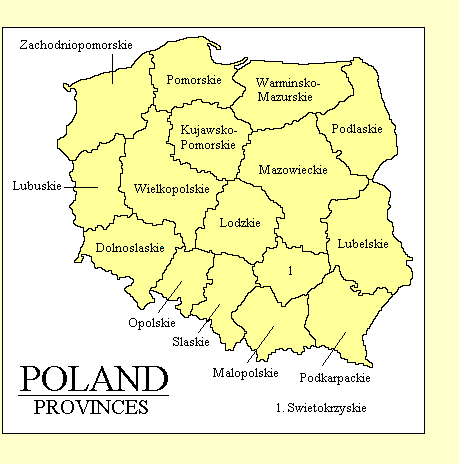
• Form of government: Parliamentary democratic republic. Poland is divided into 16 provinces.
• Capital: Warsaw (Warszawa)
• Constitution: The Constitution of the Republic of Poland was approved by referendum on 23 May 1997 and came into effect on 16 October 1997.
• Head of state: The President, elected by direct universal suffrage for a five-year term.
• Head of government: The Prime Minister, appointed by the President. The Prime Minister is the leader of the largest party in the legislature and is accountable to it.
• Legislature: Poland has a bicameral legislature. The Assembly (Sejm) has
460 members, elected for four-year terms by proportional representation in multi-member constituencies. The
Senate (Senat) has 100 members elected for four-year terms in multi-member
constituencies.
• Electoral authority: The Commission for National Elections conducts all elections.
• Freedom House 2011 rating: Political Rights 1, Civil Liberties 1
• Transparency International Corruption Index: 53% (41 of 178 countries rated)
• Reporters Without Borders Press Freedom 2010 Index: 91.2% (32 of 178 countries rated)
• Heritage Foundation Economic Freedom 2010 Index: 64.1% (68 of 178 countries rated)
Political history
The ancient Kingdom of Poland and Lithuania was partitioned in three stages by its more powerful neighbours Austria,
Prussia and Russia, finally disappearing in 1795. The collapse of these three empires in 1918 allowed Poland to
recover its independence. The new Polish state began as a parliamentary democracy, but in 1926 the nationalist leader
Jozef Pilsudski established an authoritarian regime.
Poland was swiftly defeated by Nazi Germany in September 1939. When the Soviet armed forces entered Warsaw in
1945 a Communist government was established. Elections were held in January 1947, but these were rigged by the
Communists and the democratic leader Stanislaw Mikolajczyk was driven into exile. The Communists established a
one-party dictatorship which held power for more than 40 years.
From the 1970s on Poland faced grave economic difficulties, which the Communist regime was unable to solve
while ruling an unwilling population. The trade union movement Solidarity forced a confrontation with the regime which
led to the declaration of martial law in 1981. In 1990 the Communists gave up power and free elections were held.
The Solidarity leader Lech Walesa was elected President.

Solidarity soon disintegrated as a political force, and Walesa proved an inept president. The Polish Communists
reorganised themselves into the Alliance of
Democratic Left (SLD), and the party's leader Aleksander Kwasniewski defeated Walesa at
the 1995 presidential election. The SLD also comfortably won the 2001 legislative election.
The vacuum on the right was filled by the nationalist Law
and Justice (PiS) party, led by the Kaczynski twins. In 2005 Lech Kaczynski was elected President and his twin
brother Jaroslaw became Prime Minister.
The Kaczynskis' brand of xenophobic populism did Poland's reputation in Europe
no good, and the Polish electorate soon tired of their buffoonish behaviour. In November 2007 fresh elections saw
emergence of the moderate conservative Citizens' Platform (PO) party, and its
leader Donald Tusk became Prime Minister. The SLD was
reduced to a minor third party. The old Polish People's Party (PSL) also retained
its base in the poorer rural parts of the country.
In April 2010 Lech Kaczynski was killed in a plane crash and a
moderate, Bronislaw Komorowski, was
elected President, defeating Jaroslaw Kaczynski. Tusk's government was comfortably re-elected in 2011, again
defeating Jaroslaw Kaczynski.
Updated November 2011
|