
ISLAMIC REPUBLIC OF PAKISTAN
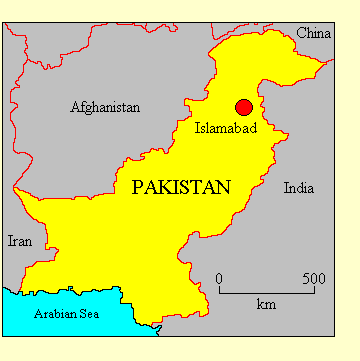
• Official name: Islamic Republic of Pakistan (Islami Jamhuriya-e-Pakistan)
• Location: South Asia
• International organisations: Commonwealth of Nations, Non-Aligned Movement,
Organisation of Islamic
Conference, United Nations, World Trade Organisation
• Borders: Afghanistan, China, India, Iran
• Coastline: Arabian Sea
• Land area: 803,940 Km2
• Population: 180,800,000
• Annual GDP (PPP) per capita: US$2,600 (2009 CIA estimate). World ranking: 139
• Ethnicity: North Indian (Indo-Aryan) people: Punjabi, Sindhi,
Pashtun (Pathan), Baloch, Muhajir
• Languages: Urdu (closely related to Hindi though written in a
different script) is the official language, though only 8% speak it as
their first language. In practice English is the language of
government. The most widely spoken languages are Punjabi 48%,
Sindhi 12%, Siraiki 10% and Pashtu 8%.
• Religion: Sunni Islam (the state religion) 77%, Shi'a Islam 20%,
Christian, Hindu and other 3%
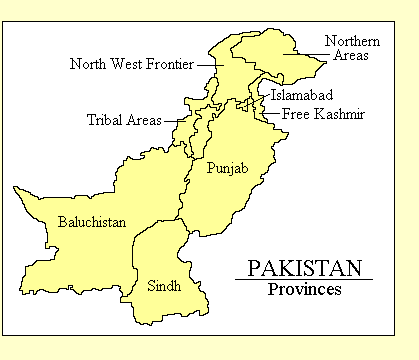
• Form of government: In theory, parliamentary democratic republic. Pakistan is divided into
four provinces and two territories which all have elected assemblies. The
Pakistani-controlled parts of Kashmir (Free Kashmir and the Northern Areas) are
under direct government administration.
• Capital: Islamabad
• Constitution: The current
Constitution of the Islamic Republic of Pakistan dates from 10 April 1973. It
was suspended during periods of military rule, 1977-85 and 1999-2002.
• Head of state: The President, elected by the National Assembly for a five-year
term.
• Head of government: The Prime Minister, appointed by the President. The Prime
Minister is usually the leader of the largest party in the National Assembly and is
accountable to it.
• Legislature: The Majlis-i-Shura (Parliament) is a bicameral
legislature. The lower house, the
National Assembly, has
342 members elected for five-year terms. Of these, 272 members are
elected in single-member constituencies. Sixty seats are reserved for
women and ten seats are reserved for ethnic minorities. These members
are nominated by the political parties. The
Senate has 100 members,
nominated by the provincial parliaments.
•
Electoral authority: The Pakistan Electoral
Commission administers national elections.
• Freedom House 2011 rating: Political Rights 4, Civil Liberties 5
• Transparency International Corruption Index: 23% (143 of 178 countries rated)
• Reporters Without Borders Press Freedom 2010 Index: 43.8% (151 of 178 countries rated)
• Heritage Foundation Economic Freedom 2010 Index: 55.1% (123 of 179 countries rated)
Political history
Pakistan occupies the western quarter of the Indian subcontinent and
until 1947 its history was that of part of India. In 1906 Indian Moslem leaders,
fearing that the Indian National Congress's agitation for independence
would lead to a Hindu-dominated India, formed the Moslem League, and
under the leadership of Mohammned Ali Jinnah they demanded a separate
Moslem state, to be called Pakistan ("Land of the Pure").
Faced with the threat of civil war the departing British acceded
to partition, and Pakistan came into existence in 1947. It originally
included East Bengal, but this territory broke away and became Bangladesh in 1971.
Pakistan has suffered from chronic bad government and instability
thoughout its history. A parliamentary system was created in 1947, but
proved weak and ineffective. There were military coups in 1958, 1977 and
1999, and in most cases the civilian governments which alternated with
military rule were corrupt or incompetent or both. The 1999 coup was widely
welcomed and parliamentary government seemed discredited.
General Pervez Musharraf, who seized power in October 1999,
redesigned the political system. In April 2002 a
plebiscite approved changes to the Constitution expanding the
President's powers and making the
Prime Minister and ministry responsible to the
President. The October 2002 legislative elections were reasonable fairly
conducted in a technical sense, but opposition parties had little access to the
media.
Pakistan's most enduring parties are the
Pakistan Peoples Party (PPP), a moderate
socialist party founded by Zulfikar Ali Bhutto and later led
by his daughter, former Prime Minister Benazir Bhutto, and the Pakistan Moslem League,
a descendant of Jinnah's party, now split in several factions. The
PML (Quaid-e-Azam) (PML(Q) faction
supported Musharraf (Quaid-e-Azam means Great Leader and is a reference to Jinnah).
Former Prime Minister Nawaz Sharif's faction, the
PML (Nawaz) (PML(N), polled
poorly in 2002.

By 2007 Musharraf had outstayed his welcome, and when he tried to dismiss
a recalcitrant Chief Justice, the result was an upsurge of protest and disorder that
prompted him to declare martial law. Although he arranged for his re-election as
president by the National Assembly, his political base had collapsed. He was forced to
agree to fresh elections, but these were postponed when Benazir Bhutto was
assassinated shortly after her return to the country.
When the elections were held
in February 2008, the PML(Q) finished a distant third behind the PPP and the PML(N), which
formed an uneasy alliance. Musharraf resigned and the new National Assembly elected Bhutto's husband
Asif Ali Zardari President, despite his
lack of qualifications and his record of corruption. Zardari appointed a PPP
politician, Yousaf Raza Gillani,
Prime Minister. The long-term heir to the dynasty is 21-year-old Bilawal Bhutto Zardari.
Freedom House's 2011
report on Pakistan
says: "Pakistan is not an electoral democracy.A civilian government and president were elected in 2008,
ending years of military rule, but the military continues to exercise de facto control over many areas of
government policy... The 2008 parliamentary elections were not completely free and fair. A European Union
observer mission noted the abuse of state resources and media, inaccuracies in the voter rolls, and rigging
of the vote tallies in some areas... Pakistan's government operates with limited transparency and accountability,
though this has improved with the resumption of civilian rule. The military has a stake in continuing to
influence both commercial and political decision-making processes, in addition to its traditional dominance
of foreign policy and security issues... Corruption is pervasive in politics and government...
Pakistan's outspoken newspapers and a growing number of private television stations present a diverse range of
news and opinion. However, powerful figures, including military officials and members of the higher judiciary,
restrict media freedom by attempting to silence critical reporting, and there is a high level of violence against
journalists... Pakistan is an Islamic republic, and there are numerous legal restrictions on religious freedom...
The rights to freedom of assembly and association are selectively upheld... Authorities generally tolerate the
work of nongovernmental organizations (NGOs) and allow them to publish critical material...
The judiciary consists of civil and criminal courts and a special Sharia court for certain offenses. Lower courts
remain plagued by corruption, intimidation, and a backlog of some 1.5 million cases that leads to lengthy
pretrial detention."
Updated November 2011
|