
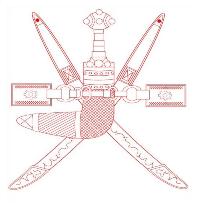
SULTANATE OF OMAN
• Official name: Saltanat Oman (sultanate of Oman)
• Location: West Asia
• International organisations: Arab League, Non-Aligned Movement, Organisation of Islamic
Conference, United Nations, World Trade Organisation
• Borders: Saudi Arabia, United Arab Emirates, Yemen
• Coastline: Arabian Sea, Gulf of Oman
• Land area: 212,460 Km2
• Population: 2,800,000
• Annual GDP (PPP) per capita: US$23,900 (2009 CIA estimate). World ranking: 40
• Ethnicity: Three-quarters of the population are Omani Arabs, although many have some
African or Baluchi descent. The remainder are immigrant workers from the Indian subcontinent, Africa and
the Philippines.
• Languages: Arabic is the official language and the language of the Omani Arab population.
About 10% speak Baluchi, an Iranian language, while 5% speak Jibbali, a South Arabian language.
There are substantial minorities speaking Indian languages such as Bengali, Gujarati, Sindhi, and Urdu,
while other minorities speak Swahili, Farsi, Filipino and Portuguese.
• Religion: Islam is the state religion. Most Omanis belong to the Ibadhi sect, while
about 20% are orthodox Sunnis. There are Hindu and Christian minorities among the immigrant population.
• Form of government: Semi-constitutional monarchy. Oman is divided into six regions and two governorates.
• Capital: Muscat
• Constitution: The
Constitution of Oman was promulgated by the Sultan on 6 November 1996.
• Head of state: Sultan
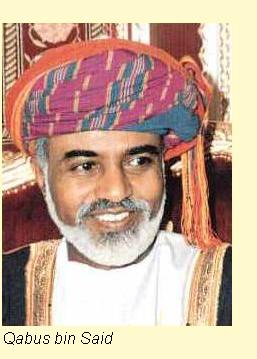
Qabus bin-Said Al-Said
assumed the throne on 23 July 1970.
• Head of government: The Sultan, who appoints all ministers.
• Legislature: Oman has a bicameral legislature, the Council of Oman (Majlis Oman). The Consultative
Assembly (Majlis al-Shura) has 84 members elected by univeersal suffrage. The Council of State
(Majlis al-Dawla) has 40 appointed members. No political parties are allowed and the legislature has
advisory functions only. The last elections to the Majlis al-Shura were in October 2007.
• Electoral authority: None.
• Freedom House 2011 rating: Political Rights 6, Civil Liberties 5
• Transparency International Corruption Index: 53% (41 of 178 countries rated)
• Reporters Without Borders Press Freedom 2010 Index: 59.7% (124 of 178 countries rated)
• Heritage Foundation Economic Freedom 2010 Index: 69.8% (34 of 179 countries rated)
Political history
Both Muscat and Oman were independent Arab states as far back as the 8th century. In
1650 Imam Ahmed bin Said drove the Portuguese out of Muscat
and re-established the country's independence: a rare defeat for European colonialism.
The Sultanate of Muscat and Oman dates from 1744 when the current dynasty took power. Until the late
19th century Zanzibar was an Omani territory, explaining the strong
African influence in Oman. In 1898 the Sultanate became a British protectorate. This
arrangement ended in 1954 but Oman retains strong links with Britain.
The country remained isolated and backward until 1970, when Sultan Qabus deposed his
father, renamed the country Oman and began a campaign of modernisation. Qabus has created the
institutions of a constitutional state, including an elected legislature and a constitution which
guarantees human rights, but he has retained all real power in his own hands. His traditional
authority as head of the Ibadhi sect has prevented serious opposition emerging. The large population of
migrant workers in Oman have no political rights.
Freedom House's 2011
report on Oman
says: "Oman is not an electoral democracy. Citizens elect the 84-member Consultative Council for four-year
terms, but the chamber has no legislative powers and can only recommend changes to new laws...
The sultan serves as the country's prime minister; heads the ministries of Defense, Foreign Affairs, and
Finance; and is the governor of Oman's central bank... Political parties are not permitted, and no
meaningful organised political opposition exists. Corruption is not perceived to be a serious problem in
Oman... Freedom of expression and democratic debate are limited, and criticism of the sultan is prohibited...
All public gatherings require official permission, and the government has the authority to prevent organised
public meetings without any appeal process... The judiciary is not independent and remains subordinate to the
sultan and the Ministry of Justice."
Updated November 2011
|