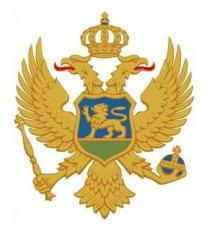
REPUBLIC OF MONTENEGRO
• Official name: Republic of Montenegro (Republika Crna Gora). Crna Gora means "Black Mountain" in Serbian, and
Monte Negro is an Italian translation of this name, dating from Venetian times.
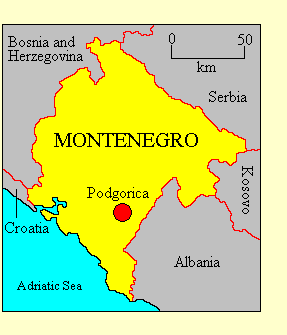
• Location: South Eastern Europe
• International organisations: Organization for Security and Co-operation in Europe, United Nations
• Borders: Albania, Bosnia and Herzegovina, Croatia, Kosovo, Serbia
• Coastline: Adriatic Sea
• Land area: 13,812 Km2
• Population: 670,000
• Annual GDP (PPP) per capita: US$9,800 (2009 CIA estimate). World ranking: 85
• Ethnicity: In 2003 43% of the population considered themselves Montenegrins, while
32% considered themselves Serbs. There is no difference in ethnicity, language or religion
between the two - the distinction is purely historical. The significant minorities are Bosniaks (Muslim Serbs)
8% and Albanians 5%.
• Languages: The great majority of the population speaks Serbian, although many chose to call it
Montenegrin. Small minorities speak Albanian and Croatian.
• Religion: About 75% are at least nominal Orthodox Christians, while about 18% are Sunni Muslims. There is a Catholic
minority.
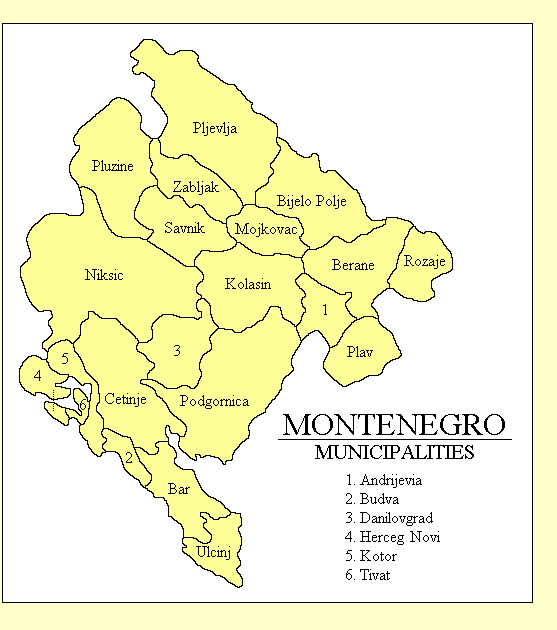
• Form of government: Parliamentary democratic republic. Montenegro is divided into 21 districts.
• Capital: Podgorica
• Constitution: The Constitution of the
Republic of Montenegro came into effect in November 1992.
• Head of state: The President, elected by direct universal suffrage for a five-year term. The President's
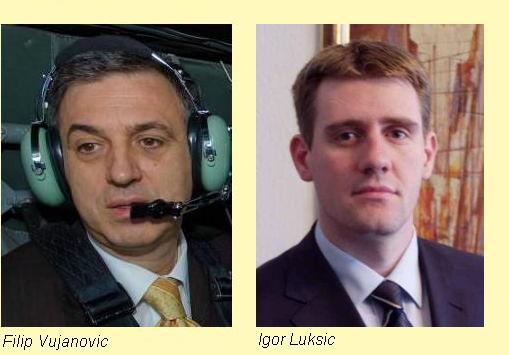
functions are largely ceremonial. President
Filip Vujanovic took office on 22 May 2003.
• Head of government: The Prime Minister, who is appointed by the President.
• Legislature: Montenegro has a unicameral legislature, the
Montenegrin Parliament (Skupstina Republike Crne Gore), which has
77 members elected for four-year terms by proportional representation.
• Electoral authority: The Centre for Free Elections
and Democracy (CEMI) (website currently under reconstruction) administers national elections.
• Freedom House 2009 rating: Political Rights: 3, Civil Liberties: 3
Political history
The state of Montenegro has its origins in the Principality of Zeta, formed in the 15th century as an enclave of
Serbian Slavs on the Adriatic coast who resisted conquest by the Ottoman Turks. The principality was ruled for many
years by the Archbishops of Cetinje, then by secular princes from 1852. Montenegro was recognised as an independent
state in the 1870s. In 1910 Prince Nikola I declared himself King of Montenegro. The Kingdom was enlarged after the
Balkan Wars of 1912. In 1918 Montenegro voted to become part of the new South Slav kingdom, later called Yugoslavia.
During World War II it was occupied by Italian and German forces.
In 1945 Montenegro became a constituent republic of the new communist controlled Yugoslav state. When
Yugoslavia was dissolved in 1992 and four of its six republics became independent, Montenegro opted to remain linked
to Serbia in a new Yugoslav federation. In 2003 a new, looser, federation was agreed on under the name
Serbia and Montenegro. But mounting dissatisfaction in Montenegro led to a referendum in May 2006, in which 55% of
Montenegrins voted for independence. This was accepted by Serbia and both states became fully independent on 3 June
2006.
Despite the achievement of independence, Montenegro's politics continue to be polarised between
pro-independence and
pro-Serbian forces. The dominant party since independence has been President Vujanovic's Democratic Party of
Socialists of Montenegro (DPSCG), which operates as part of the Montenegro for Europe (ECG) coalition. (Neither the
party nor the coalition appears to have a website, although ECG has both a Facebook page and a Youtube channel.) The
DPSCG leader Igor Luksic has been Prime Minister since
December 2010, when he took over following the retirement of the long-serving Milo Djukanovic. The main opposition party is the
pro-Serbian Socialist People's Party (SNPCG).
Freedom House's 2009
report on Montenegro
says: "Montenegro is an electoral democracy. International observers reported that the independence referendum, the
2006 parliamentary elections, and the 2008 presidential election were conducted freely and fairly,
though with minor irregularities... Corruption in Montenegro, according to the EU, is "a widespread and particularly
serious problem," although some progress in the fight against organized crime was reported in 2008. The corruption
problem is partly a legacy of the struggle against the Milosevic regime in the 1990s, when the state turned to
various forms of smuggling to finance government operations... Montenegro was ranked 85 out of 180 countries surveyed
in Transparency International's 2008 Corruption Perceptions Index... Freedom of the press is generally respected, but
journalists who criticise the government have been attacked on a number of occasions... Citizens enjoy freedoms of
association and assembly. Foreign and domestic NGOs are able to pursue their activities without state interference...
The judicial system lacks independence from political authorities, and judicial corruption remains a significant problem."
Updated March 2011
|