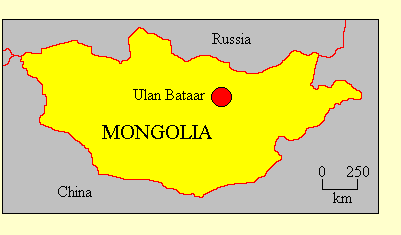
REPUBLIC OF MONGOLIA
• Official name: Mongol Uls (Republic of Mongolia)
• Location: North Asia
• International organisations: Non-Aligned Movement, United Nations, World Trade Organisation
• Borders: China, Russia
• Coastline: None
• Land area: 1,565,000 Km2
• Population: 2,700,000
• Annual GDP (PPP) per capita: US$3,200 (2009 CIA estimate). World ranking: 133
• Ethnicity: Mongol 85%, Kazakh and other Turkic peoples 7%, Tungusic 4.6%, other 3.4%.
• Languages: Mongol is the official language and is spoken by 90% of the population.
Russian and Kazakh are also used.
• Religion: Over 95% of the population are Buddhists. There are small Moslem and Christian minorities.
• Form of government: Parliamentary democratic republic. Mongolia is divided into 21 provinces and one
municipality.
• Capital: Ulan Bataar
• Constitution: The
Constitution of the Republic of Mongolia came into effect on 13 January 1992.
• Head of state: The President, elected by direct universal suffrage for a
four-year term. The President's functions are largely ceremonial. President
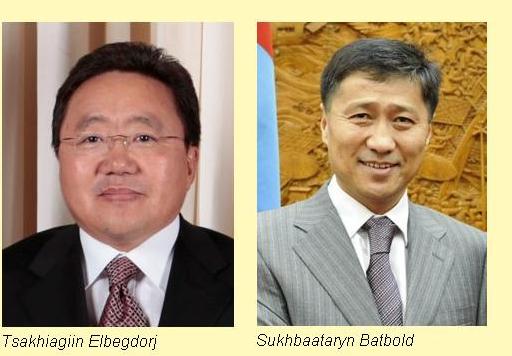
Tsakhiagiin Elbegdorj
took office on 18 June 2009.
• Head of government: The Prime Minister, appointed by the President. The Prime Minister is the
leader of the largest party in the legislature and is accountable to it.
• Legislature: Mongolia has a unicameral legislature, the
Great People's Assembly (Ulsyn Ikh-Khural), which has 76 members
elected for four-year term from single-member constituencies.
• Electoral authority: The Central Electoral Commission administers
national elections.
• Freedom House 2011 rating: Political Rights 2, Civil Liberties 2
• Transparency International Corruption Index: 27% (116 of 178 countries rated)
• Reporters Without Borders Press Freedom 2010 Index: 80.6% (76 of 178 countries rated)
• Heritage Foundation Economic Freedom 2010 Index: 59.5% (94 of 179 countries rated)
Political history
The political power of the Mongols reached a peak under Kublai Khan in the 13th century, and then
declined until 1691, when the Mongol lands were brought under Chinese sovereignty. Mongolia was a Chinese
province until 1911, when the overthrow of the Chinese monarchy allowed Russia to extend its influence
in the area. In 1912 Russia declared Outer Mongolia - the area of the present Mongolian state - a Russian
protectorate.
The Russian Revolution and civil war allowed the Chinese to re-assert their control. But in 1921
Mongolian nationalists, aided by the Russian communists, declared Outer Mongolia independent, and in 1924
the Mongolian People's Republic was proclaimed. China did not recognise the independence of Mongolia until
1950, and the Chinese Nationalists in Taiwan still claim Mongolia as part of China.
Communist Mongolia was in effect a dependency of the Soviet Union. The Buddhist monarchy was
abolished and argiculture collectivised, with the usual disastrous results. From 1939 Mongolia was ruled
by Marshall Horloogiyn Choybalsan, Stalinist head of the Mongolian People's Revolutionary Party. After his
death in 1952, communist rule became more moderate under his successor Yumjaagiyn Tsedenbal. The
Sino-Soviet dispute of the 1960s led to tighter Soviet control over Mongolia.
The decline of Soviet power soon influenced events in Mongolia, and in 1991 the communist leader
Jambyn Batmönh agreed to a multi-party system and economic reforms. In 1996, the democratic opposition
parties defeated the reformed communists in free elections, though they regained power in 2000.
Despite severe economic difficulties, Mongolia has become a stable democratic state. The
reformed Mongolian People's Revolutionary Party (MAKN) has alternated in power
with the Mongolian National Democratic Party (AN), a conservative
free-market party. Other parties include the Mongol Democratic New Socialist Party, the liberal
Civil Courage Party, the Mongolian Green Party and the Motherland Alliance.
The 2004 elections produced a deadlock between the MAKN and the AN, and a composite government was
formed which governed until 2006, when the MAKN formed a minority government under Sanjaagiin Bayar. At the
2008 election the MAKN won a comfortable majority, and Bayar formed a majority government. Allegations of
vote-rigging by the AN (apparently with little foundation)
led to riots in the capital in which four people were killed. Bayar resigned for
health reasons in October 2009 and was succeeded by
Sukhbaataryn Batbold.
In 2009 the AN candidate Tsakhiagiin Elbegdorj was elected President.
Freedom House's 2011
report on Mongolia
says: "Mongolia is an electoral democracy. The 2009 presidential election was generally considered free and fair
by international observers... Corruption remains a serious problem in Mongolia [and] the government operates
with limited transparency... While the government generally respects press freedom, many journalists and independent
publications practice a degree of self-censorship to avoid legal action under the State Secrets Law or libel laws that
place the burden of proof on the defendant... Freedoms of assembly and association are observed in law and in
practice... The judiciary is independent, but corruption among judges persists. The police force has been known to make
arbitrary arrests, hold detainees for long periods, and beat prisoners."
Updated November 2011
|