ISLAMIC REPUBLIC
OF MAURITANIA
• Official name: Al-Jumhuriya al-Islamiya al-Muritaniya / Republique Islamique du
Mauritanie (Islamic Republic of Mauritania)
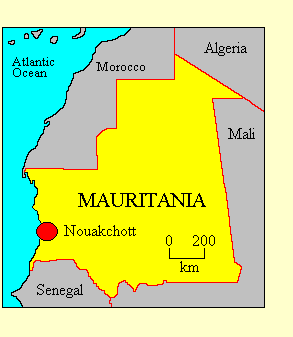
• Location: West Africa
• International organisations: African, Caribbean and Pacific Group of States, African Union,
Arab League, Non-Aligned Movement, Organisation Internationale de la Francophonie,
Organisation of Islamic Conference, United Nations, World Trade Organisation
• Borders: Algeria, Mali, Senegal, Western Sahara (Moroccan occupied)
• Coastline: Atlantic Ocean
• Land area: 1,030,700 Km2
• Population: 3,300,000
• Annual GDP (PPP) per capita: US$2,100 (2009 CIA estimate). World ranking: 153
• Ethnicity: Two thirds of the population are classified as Moors, meaning of
mixed Arab and Berber descent. The remainder are of West African descent, many the descendants
of slaves and socially marginalised.
• Languages: Standard Arabic and French are the official languages, but the Moors speak
Hassaniyya, a local dialect form of Arabic. A number of African languages including
Pulaar, Soninke and Wolof are spoken in the south. French is widely used in government
and business.
• Religion: Islam is the state religion and almost the entire population are Sunni Moslems.
• Form of government: Presidential republic. Mauritania is divided into 12 regions and
the capital city district.
• Capital: Nouakchott
• Constitution: The
Constitution of the Islamic Republic of Mauritania came into effect on 12 July 1991.
• Head of state: The President, in theory elected by direct universal suffrage for a
six-year term.
• Head of government: The Prime Minister, appointed by the President and in practice
accountable to him.
• Legislature: Mauritania has a bicameral legislature, the Parliament (Barlamane /
Parlement). The National Assembly
(Al Jamiya al-Wataniyah / Assemblee Nationale) has 95 members, elected for five-year
terms from single-member constituencies. The Senate (Majlis al-Shuyukh / Senat)
has 56 members, of whom 53 are elected for six-year terms by municipal councillors.
Three members represent Mauritanians abroad. The legislature has no website.
• Electoral authority: The Ministry of the Interior administers national elections.
• Freedom House 2011 rating: Political Rights 6, Civil Liberties 5
• Transparency International Corruption Index: 23% (143 of 178 countries rated)
• Reporters Without Borders Press Freedom 2010 Index: 74.4% (95 of 178 countries rated)
• Heritage Foundation Economic Freedom 2010 Index: 52.1% (134 of 178 countries rated)
Political history
The coastal areas of Mauritania were ruled by several independent Arab emirates until
late in the 19th century, when the French advanced into the area from Senegal. In 1900
Mauritania was formally annexed by France and 1904 it was incorporated into French West
Africa. In 1920 Mauritania became a separate colony, and in 1946 a local assembly was
established. Mauritania became self-
governing within the French Community in 1958 and independence followed in November 1960.

Mauritania's first president, Mokhtar Ould Daddah, established a typical African
one-party state, though not a particularly oppressive one. In 1976 he joined with
Morocco in partitioning the Spanish territory of Western Sahara. The resulting
guerilla warfare by Saharan nationlists, combined with a prolonged drought, increased
discontent with Daddah's regime and he was deposed in a coup in 1978.
After a period of miltary rule, a second coup in 1984 brought
Maaouya Ould Sid'Ahmed Taya to power. In 1991 he agreed to a restoration of civilian
government and multi-party politics, and he was elected President in 1992. His
regime remained authoritarian, and opposition parties boycotted both the 1997
presidential elections and the 2001 legislative elections.
In June 2003 there was an unsuccessful coup attempt, apparently staged by Islamist radicals.
In August 2005 a second coup succeeded in toppling Taya. The new regime held presidential elections in
2007, which one of its members, Sidi Ould Cheikh Abdallahi, won. These were the first genuine free elections
in the country's history. Almost immediately, however, the officers
who had staged the 2005 fell out among themselves, and in August 2008 General
Mohamed Ould Abdel Aziz
staged yet another coup. Like his predecessor, Abdel Aziz sought to legitimise his rule by holding
elections, and in May 2009 he was duly elected, polling 53% against a divided opposition. Although observers
from the African Union pronounced the election "satifactory," Abdel Aziz had great advantages
of incumbency.
Freedom House's 2011 report on Mauritania
says: "Mauritania is not an electoral democracy.The transitional elections of 2006 and 2007 were generally
praised by independent observers, but the constitutional government was ousted by the August 2008 military coup.
Serious doubts have been raised about the legitimacy of the 2009 presidential election, which installed coup
leader Mohamed Ould Abdel Aziz as the civilian president... Corruption is believed to be a serious problem, and
political instability has helped to prevent fiscal transparency from taking root in recent years...
Journalists continue to practice self-censorship, and private newspapers face the threat of closure for material
seen as offensive to Islam or threatening to the state... The 1991 constitution guaranteed freedoms of association
and assembly, and conditions grew more permissive when civilian rule was restored after the 2005 coup. In the
wake of the 2008 coup, however, the junta banned protests and allowed only supporters to demonstrate...
The judicial system is heavily influenced by the government. Many decisions are shaped by Sharia (Islamic law),
especially in family and civil matters."
Updated November 2011
|