
REPUBLIC OF MALDIVES
• Official name: Dhivehi Raajjeyge Jumhooriyyaa / Republic of Maldives
• Location: Indian Ocean
• International organisations: Commonwealth of Nations, Non-Aligned Movement,
Organisation of Islamic Conference, United Nations, World Trade Organisation
• Borders: None
• Coastline: Indian Ocean
• Land area: 300 Km2
• Population: 400,000
• Annual GDP (PPP) per capita: US$4,200 (2009 CIA estimate). World ranking: 124
• Ethnicity: The people of the Maldives are a mixture of South Indians, Sri Lankan Singhalese and Arabs.
• Languages: English is the official languages. The people speak Maldivian Dhivehi, a dialect of Singhalese.
• Religion: Almost the entire population are Sunni Muslims.
• Form of government: Presidential republic
• Capital: Male
• Constitution: The Constitution of
the Maldives came into effect in January 1998.
• Head of state: The President, elected by the people for a five-year term.
• Head of government: The President, who appoints all ministers.
• Legislature: The Maldives has a unicameral legislature, the
People's Council (Majlis), which has 77 members elected from
single-member constituencies.
• Electoral authority: The Maldives Election Commission administers
national elections.
• Freedom House 2011 rating: Political Rights 4, Civil Liberties 3
• Transparency International Corruption Index: 25% (134 of 178 countries rated)
• Reporters Without Borders Press Freedom 2010 Index: 84% (52 of 178 countries rated)
• Heritage Foundation Economic Freedom 2010 Index: 49.2% (151 of 179 countries rated)
Political history
The Maldives were originally settled by Sinhalese from Sri Lanka, but were converted to Islam by the Arabs and
became an independent Sultante in the 12th century. The islands were seized by the Portuguese in the 16th century but
soon recovered their independence. The Dutch also tried to establish control but were repulsed. In the 19th century
the influence of Britian India became paramount and in 1887 the islands became a British protectorate. In 1953
self-government was granted and the Sultante was abolished, but was reinstated the following year. The Maldives
became fully independent in July 1965. The Sultanate was finally overthrown in 1968 and a republic established. In
1978 Maumoon Abdul Gayoom became President and ruled with little opposition for 30 years. In 2008, he allowed free
elections and was defeated by Mohamed Nasheed of the Maldives Democratic Party.
In 2009 the country's first multi-party legislative elections were held. But Gayoom's supporters continued to conspire
against the new order, and in early 2012 a police mutiny broke out in the capital, prompting Nasheed's resignation. He
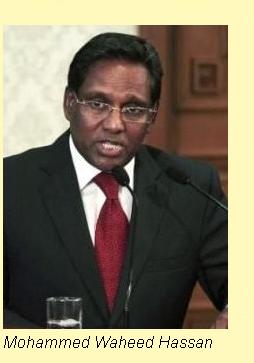
was succeeded by his Vice-President, Mohammed Waheed
Hassan, who seems to have been complict in undermining Nasheed's government.
Freedom House's 2011
report on the Maldives
(which obviously was written before the 2012 crisis) says: "The Republic of Maldives is an electoral democracy. The first
democratic presidential election in 2008 was deemed relatively free and fair, although observers reported flaws
including some preelection violence, a compressed timeframe, and voter registration problems. The interim election
commission was considered generally professional, transparent, and impartial. The 2009 parliamentary elections were
also judged to be largely credible, despite minor problems related to the compilation of the voter list as well as some
intimidation and other irregularities... A new, independent auditor general and the revised constitution have provided
greater transparency, shedding light on pervasive corruption. An Anti-Corruption Commission (ACC) established in 2008
opened dozens of cases in 2009, but none had been concluded by the end of 2010... The new constitution guarantees
freedoms of expression and the press. While restrictions on speech deemed "contrary to the tenets of Islam" remain in
place, defamation was decriminalised in 2009.Private print media have expanded and present a diversity of
viewpoints... Freedom of religion remains severely restricted. Islam is the state religion, and all citizens are required
to be Sunni Muslims... The new constitution provides for an independent judiciary, and judges were sworn into the first
Supreme Court and final court of appeals in 2008. Courts have subsequently shown signs of increased independence from the
executive."
Updated March 2012
|