PRINCIPALITY OF LIECHTENSTEIN
• Official name: Furstentum Liechtenstein (Principality of Liechtenstein)
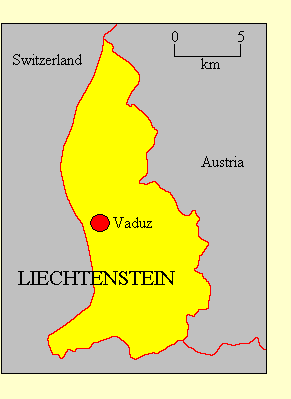
• Location: Western Europe
• International organisations: Council of Europe, Organisation for Security and Co-operation in
Europe, United Nations, World Trade Organisation
• Borders: Austria, Switzerland
• Coastline: None
• Land area: 160 Km2
• Population: 36,000
• Annual GDP (PPP) per capita: US$122,100 (2009 CIA estimate). World ranking: 1. On this ranking Liechtenstein
is the wealthiest country in the world.
• Ethnicity: Virtually the entire population is of German ethnicity.
• Languages: German is the official language and is universally used.
• Religion: Most of the population are at least nominal Catholic Christians.
• Form of government: Monarchy. Liechtenstein is divided into
11 communes. For electoral purposes it is divided into two regions.
• Capital: Vaduz
• Constitution: The
Constitution of Liechtenstein came into effect on 5 October 1921.
It was substantially amended in 2003.
• Head of state: Prince Prince
Hans-Adam II
assumed the throne on 13 November 1989.
• Head of government: The Head of Government (Regierungschef), appointed by the Prince. The amendments to the
constitution in 2003 make the Prince the effective ruler of Liechtenstein.
• Legislature: Liechtenstein has a unicameral legislature, the
Assembly (Landtag), which has 25 members elected
for four-year terms by proportional representation from two multi-member districts.
• Electoral authority: The government administers national elections
• Freedom House 2009 rating: Political Rights 1, Civil Liberties 1 (I disagree with this rating, since the constitutional revisions of 2003 have substantially
reduced the democratic nature of Liechtenstein's government.)

Political history
The County of Vaduz was part of the Holy Roman Empire and was bought by Prince Johann
Adam Andreas of Liechtenstein (the name of a castle near Vienna) in 1699. He was recognised by the Holy Roman Emperor
Karl VI as Prince of Liechtenstein in 1719. Liechtenstein became a sovereign state in 1806 when the Empire was dissolved.
Its independence was confirmed in the settlement of 1815. In 1862 a new Constitution was promulgated, which provided for an
elected Landtag. In 1918 Liechtenstein formed a customs and monetary union with Switzerland, and in 1919 also entrusted
its external relations to Switzerland. In 1938 Prince Franz Josef II became the first Prince to actually live in
Liechtenstein.
In March 2003 the voters of Liechtenstein approved a referendum was giving Prince Hans-Adam the
right to dismiss governments, dismiss individual ministers, make judicial apointments and veto laws. The referendum also
precludes any further amendments to the constitution without the Prince's approval unless the monarchy is abolished, and
abolished the jurisdiction of the courts over constitutional matters. This amounted to a decisive shift of power
from the legislature to the Prince.
Liechtenstein politics are dominated by two conservative parties, the
Progressive Citizens' Party in Liechtenstein (FBL) and the
Patriotic Union (VU). The only non-conservative voice in Liechtenstein politics
is the Free List, a minor Green party. At the March 2009 election, the VU won a majority
of seats in the Landtag, taking seats from both the other parties. The VU leader,
Klaus Tschutscher,
became Prime Minister.
Updated March 2010
|