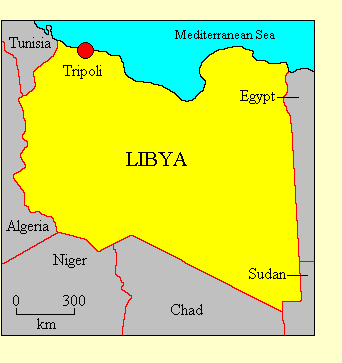
LIBYA
• Official name: The new Libyan government has not yet determined the country's official
name. It is often referred to as the Republic of Libya (Al-Jumahiriyah al-Libiyah) but this is not
official.
• Location: North Africa
• International organisations: African, Caribbean and Pacific Group of States, African Union, Arab League,
Non-Aligned Movement, Organisation of Islamic Conference, Organisation of Petroleum Exporting Countries, United Nations
• Borders: Algeria, Chad, Egypt, Niger, Sudan, Tunisia
• Coastline: Mediterranean Sea
• Land area: 1,759,540 Km2
• Population: 6,400,000
• Annual GDP (PPP) per capita: US$15,200 (2009 CIA estimate). World ranking: 56
• Ethnicity: About 90% of the population are Libyans, most of whom are of
either Arab or Berber descent. There is a substantial non-citizen minority of
people from African countries, and also minorities of Italians, Egyptians,
Greeks, Maltese, Pakistanis and Tunisians.
• Languages: Arabic is the official language and is almost universally used.
Berber languages are spoken in the interior. English and Italian are used
in business and communications.
• Religion: Sunni Islam is the state religion and is the religion of almost
the entire Libyan population. Other religions are tolerated among the non-citizen
minorities.
• Form of government: Transitional. Libya is divided into 25 municipalities.
• Capital: Tripoli (Tarabulus)
• Constitution: Libya currently has no constitution.
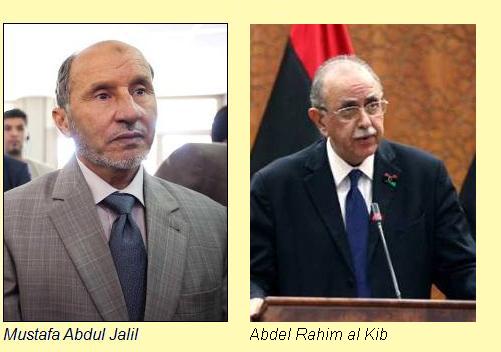
• Head of state: There is no constitutional head of state. The head of the Transitional National Council is
Mustafa Abdul Jalil.
• Head of government: There is no constitutional head of government.
Abdel Rahim al Kib was named Transitional
Prime Minister on 31 October 2011.
• Legislature: Libya currently has no legislature.
• Electoral authority: None
• Freedom House 2011 rating: Political Rights 7, Civil Liberties 7
• Transparency International Corruption Index: 22% (146 of 178 countries rated)
• Reporters Without Borders Press Freedom 2010 Index: 36.5% (160 of 178 countries rated)
• Heritage Foundation Economic Freedom 2010 Index: 38.6% (173 of 178 countries rated)
These ratings apply to the former Gaddafi regime.
Political history
The Arab emirates of Tripolitania and Cyrenaica were conquered by the Ottomans in
the 16th century. For most of the Ottoman period, however, the Arab emirs retained local
autonomy. In 1911 both emirates were seized by Italy, although the Italians never gained
full
control of the interior. In 1939 Mussolini's regime formally annexed Libya to Italy.
Libya was a major battlefield of World War II, being finally occupied
by the British in 1943. In 1950 the United Nations
decided that it would become independent in 1952. The emir of Cyrenaica, Idris
al-Sanussi, became a constitutional monarch. Elections were held through the 1950s and
constitutional government maintained. Oil discoveries made Libya a wealthy country.
In September 1969 a group of army officers led by a 27-year-old Colonel, Muamar Gaddafi, overthrew the monarchy and established a socialist republic. Although al-Qaddafi held
no official position, he remained the country's absolute ruler for the next 42 years. In 1977 the
formal constitutional system was abolished and an elaborate structure of "People's
Congresses" established. Despite this facade of popular participation, Libya remained a
military dictatorship.
The success of the revolutions in Tunisia and Egypt in January-February 2011 triggered riots and then a rising in
Cyrenaica, where the
Tripolitanian-dominated Gaddafi regime had never been popular. The rebels gained control of the eastern half of the country, but
were unable to defeat Gaddafi's grip on Tripolitania. In March the UN Security Council authorised NATO airstrikes to
prevent Gaddafi reconquering Cyrenaica and slaughtering the rebels. This was followed by a six-month civil war which ended with the fall of
Tripoli to the rebels in September. Libya is now governed by a National Transition Council, which is recognised
by the United Nations and most governments. Elections are promised when order and stable government have been restored.
Freedom House's 2011
report on Libya
is now out of date.
Updated November 2011
|