STATE OF KUWAIT
• Official name: State of Kuwait (Dawlat al-Kuwait)
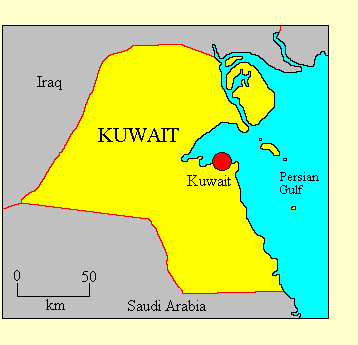
• Location: West Asia
• International organisations: Arab League, Non-Aligned Movement, Organisation of Islamic
Conference, Organisation of Petroleum Exporting Countries, United Nations, World Trade
Organisation
• Borders: Iraq, Saudi Arabia
• Coastline: Persian Gulf
• Land area: 17,820 Km2
• Population: 3,000,000
• Annual GDP (PPP) per capita: US$54,100 (2009 CIA estimate). World ranking: 5
• Ethnicity: Only 45% of the population are Kuwaiti Arabs. Another 35%
are Arabs from other Arab countries, the largest groups being Egyptians,
Lebanese and Palestinians. The remainder are immigrants from South Asia,
Iran and the Philippines.
• Languages: Arabic is the official language
and is spoken by 80% of the population. Indian languages, Farsi and
Filipino are spoken in the immigrant communities.
• Religion: Islam is
the state religion and the religion of nearly all the Arab population
(Sunni 70%, Shi'a 30%). There are small Hindu and Christian minorities.
• Form of government: Semi-constitutional monarchy. Kuwait is divided
into five governorates.
• Capital: Kuwait
• Constitution: The Constitution
of Kuwait came into effect on 11 November 1962.
• Head of
state: The Emir of Kuwait,
Sheikh Sabah IV (Sabah
Al-Ahmad Al-Jabir Al-Sabah), came to the throne on 29 January 2006
• Head of government: The Prime
Minister, appointed by the Emir. The Prime Minister is always a member of the
royal family and holds office at the Emir's pleasure. The current Prime Minister is
Nasser Al-Mohammed Al-Ahmed Al-Sabah,
the Emir's nephew.
• Legislature: Kuwait has a unicameral legislature, the National Assembly (Majlis al-Umma),
which has 50 members elected for four-year terms in five ten-member
constituencies.
• Electoral authority: The Kuwait Election Commission conducts elections. It does not appear
to have a website. The Kuwait Politics Database carries Kuwait
election results, but it's all in Arabic.
• Freedom House 2009 rating: Political Rights 4, Civil Liberties 4

Political history
The Emirate of Kuwait has existed since the 17th century, and has been ruled by the
al-Sabah family since 1756. Until the 19th century the Emirs were subjects of the
Ottoman Sultan, but in 1899 the British established a protectorate, and
in 1914 the nominal sovereignty of the Sultan was ended. The discovery of oil in 1938
made Kuwait a wealthy country, and the British had to fend off claims by both Iraq and
Saudi Arabia. Independence was delayed until Iraq renounced its claim in 1962.
In 1963 the Emir granted a constitution and males of Kuwaiti ancestry elected an
assembly, but real power was retained by the al-Sabah family. The development of industry
brought an influx of foreign workers, who were the majority of the population by the
1970s but gained no civil or political rights. The legislature was suspended in 1976,
revived in 1981, suspended again in 1986, and revived again in 1992.
In August 1990 Iraq suddenly invaded and annexed Kuwait, on the pretext of a
dispute over oil production. In February 1991 an American-led coalition force liberated
Kuwait and restored the Emir. Promises of liberalisation after the war were not kept until recently.
Since 2003 there has been considerable liberalisation, with all Kuwaiti born citizens, male and
female, gaining the vote in 2006. In 2009 women were elected to the National Assembly for the first time.
The rule of the al-Sabahs is increasingly resented, but Kuwait's immense oil wealth helps prevent
serious opposition to the regime.
Freedom House's 2009
report on Kuwait
says: "Kuwait is not an electoral democracy. The ruling family largely sets the policy agenda and
dominates political life. The emir has overriding power in the government system and appoints the
prime minister and cabinet. Under the constitution, the emir shares legislative power with the
National Assembly... Formal political parties are banned, but political groupings, such as
parliamentary blocs, have been allowed to emerge... Corruption has been a dominant political issue in
recent years, with lawmakers placing considerable pressure on the government to tackle the problem.
Kuwait was ranked 65 out of 180 countries surveyed in Transparency International's 2008 Corruption
Perceptions Index... While a 2006 press law requires officials to obtain a court order to close
newspapers, the authorities continue to limit criticism and debate on politics in the press...
The government imposes constraints on freedoms of assembly and association, although those rights are
provided by law... Kuwait lacks an independent judiciary. The emir appoints all judges, and the executive
branch approves judicial promotions."
Updated March 2010
|