DEMOCRATIC PEOPLE'S
REPUBLIC OF KOREA
• Official name: Choson-Minjujuui-Inmin-Konghwaguk (Democratic People's Republic of Korea).
The standard Korean word for "Korea" is Han-guk, but the DPRK prefers the word Choson, which was the
name of an ancient Korean kingdom.
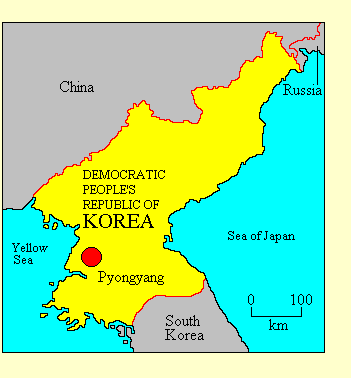
• Location: North Asia
• International organisations: Non-Aligned Movement, United Nations
• Borders: China, Republic of Korea, Russia
• Coastline: Sea of Japan, Yellow Sea
• Land area: 120,540 Km2
• Population: 23,900,000
• Annual GDP (PPP) per capita: US$1,900 (2009 CIA estimate). World ranking: 154
• Ethnicity: Almost the entire population is of Korean ethnicity.
• Languages: Korean is the official language and is universally used.
• Religion: The DPRK is an officially atheist state and religious practice is barely tolerated. The country is traditionally
Buddhist and Confucianist, with a small Christian minority.
• Form of government: Hereditary dictatorship. The DPRK is divided into nine provinces and four special cities.
• Capital: Pyongyang
• Constitution: The DPRK
Constitution dates from 1948 but bears little relation to the actual system of government. It was revised in 1998, and
is apparently being revised again in 2009.
• Head of state: The Constitution designates the late Kim Il-sung as "Eternal President." The President of the Supreme
People's Assembly Presidium represents the state and receives diplomatic credentials, but has no constitutional or political functions.
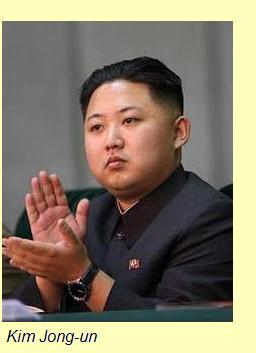
The DPRK describes the National Defense Commission as the "highest administrative authority" of the state. Its chairman, Kim Jong-un,
is the effective head of state.
• Head of government: The Prime Minister, in theory chosen by the legislature but in practice a purely administrative
official accountable to the Communist Party.
• Legislature: The DPRK's unicameral legislature, the Supreme People's Assembly, has 687 members, who serve
five-year terms. This body was last "elected" in March 2009. Only candidates of the Democratic Front for the
Reunification of the Fatherland, which is dominated by the Communist Party (officially called the Workers Party
of Korea), were nominated. The legislature is entirely decorative.
• Electoral authority: None
• Freedom House 2009 rating: Political Rights 7, Civil Liberties 7
Political history
There is little to be said about the political history of the DPRK. Until 1945 its history was the same as that
of South Korea. The Soviet Union installed Kim Il-sung as North Korea's ruler, and he exercised an absolute autocracy
of the most extreme Stalinist type until his death in 1994. He was succeeded by his son Kim Jong-il, and in turn
by his grandson Kim Jong-un when Kim Jong-il died in 2011.
Since the fall of the Soviet Union and the restoration of capitalism in China the DPRK has become almost
completely isolated, economically and politically. Its economy is in ruins and by the late 1990s its people were
starving. The regime maintains a huge military establishment and is developing nuclear weapons. It survives by
blackmailing "aid" money from South Korea and Japan. It seems likely that that sooner or later the regime will
suffer some sort of internal collapse.
Freedom House's 2009 report on North Korea
says: "North Korea is not an electoral democracy... North Korea's parliament, the Supreme People's Assembly, is a
rubber-stamp institution [which] meets irregularly for only a few days each year... North Korea was not ranked in
Transparency International's 2008 Corruption Perceptions Index, though corruption is believed to be endemic at every
level of the state and economy... The constitution provides for freedom of speech and the press, but in practice these
rights are nonexistent... The economy remains both centrally planned and grossly mismanaged. Corruption is rampant, and the
military garners over a third of the state budget."
Updated January 2012
|