REPUBLIC OF KOREA
• Official name: Taehan-min'guk (Republic of Korea)
(The Korean word for "Korea" is Han-guk)
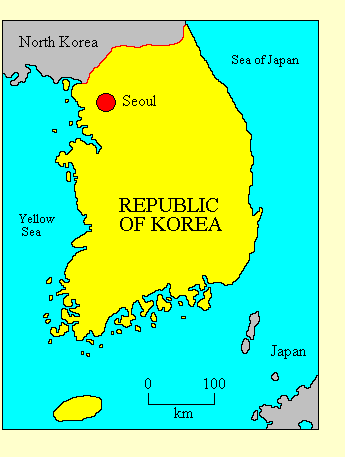
• Location: North Asia
• Borders: Democratic People's Republic of Korea
• International organisations: Asia-Pacific Economic Co-operation Forum, Group of Twenty,
Organisation for Economic
Co-operation and Development, United Nations, World Trade Organisation
• Coastline: Sea of Japan, Yellow Sea
• Land area: 98,480 Km2
• Population: 48,400,000
• Annual GDP (PPP) per capita: US$28,000 (2009 CIA estimate). World ranking: 36
• Ethnicity: Almost the entire population is of Korean stock.
• Languages: Korean is the national and universal language.
• Religion: Christian 49%, Buddhist 47%, Confucianist 3%
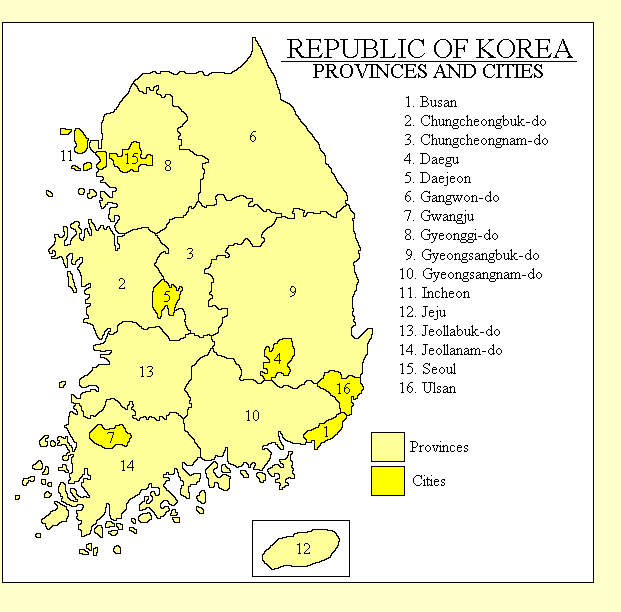
• Form of government: Presidential democratic republic. The Republic is divided into
nine provinces and seven metropolitan cities.
• Capital: Seoul
• Constitution: The new Korean
Constitution came into effect on 25 February 1988.
• Head of state: The President, elected for a five-year term by direct universal
suffrage. The Constitution makes the President the effective head of the government.
• Head of government: The Prime Minister, appointed by the President and accountable to him.
• Legislature: The Republic of Korea has a unicameral legislature, the
National Assembly (Kuk Hoe), which has
273 members, elected for four-year terms. Of these, 227 members are elected from
single-seat constituencies and 46 members by proportional representation.
• Electoral authority: The National
Election Commission of the Republic of Korea conducts elections. Its slogan is "Judge
wisely and choose precisely, or a bright future will not be reserved for you."
• Freedom House 2011 rating: Political Rights 1, Civil Liberties 2
• Transparency International Corruption Index: 54% (39 of 178 countries rated)
• Reporters Without Borders Press Freedom 2010 Index: 86.7% (42 of 178 countries rated)
• Heritage Foundation Economic Freedom 2010 Index: 69.8% (35 of 179 countries rated)
Political history
The ancient but enfeebled Korean monarchy succumbed to Japanese expanionism in
1910, and Korea spent 35 years under Japanese occupation, which is still bitterly resented.
In 1945 the Soviet Union occupied the northern half of the peninsula and the United
States the southern half. Each set up governments of their ideological persuasion.
The southern government was led by the veteran nationalist Lee Seung-Man (known in the
west as Syngman Rhee).
In 1950 the North Koreans launched a sudden military attack on the South. Three
years of warfare followed, before United Nations forces stablised the situation along
the present border and a cease-fire was agreed on. There has never been a permanent
settlement and United States forces are still stationed along the border. Lee's
regime was autocratic and oppressive, but reasonably free elections were held in the later
1950s.
In 1961 Lee was forced to retire and an army general, Park Jung-Hee, took
office. From 1963 to 1971 Park ruled as an elected president, but in 1971 he
declared himself "President for life" and thereafter ruled as a dictator. Following
his assassination in 1979, there was a brief period of civilian rule, followed by
another coup led by General Chun Doo-hwan. This coup was accompanied by a massacre
of civilians in the southern city of Kwangju.
Chun ruled as a dictator until 1987, when he was succeeded by General Roh Tae-woo.
Under domestic and international pressure, Roh agreed to allow free presidential
elections in December 1987. Since then South Korea has been a stable and increasingly
prosperous democracy, though overshadowed by fear of the isolationist and impoverished Communist
regime in the North.

The veteran dissident leader Kim Dae-Jung was elected President in 1997. In 2003
he was succeeded by another member of his
United Democratic Party (UDP), Roh Moo-hyun. The UDP is a liberal party which
favours negotiations with the North and a gradual withdrawal of American forces from
Korea. The opposition Grand National
Party (GNP) is more conservative and favours a tough line with the North.
The failure of Kim and Roh's diplomatic overtures to North Korea, and the increasing
corruption of Roh's term (after leaving office he committed suicide), led to a waning of
support for the UNDP and the victory of the GNP's
Lee Myun-Bak at the 2007 presidential elections.
Since the 2008 legislative elections the GNP has also had a large majority in the National Assembly.
Freedom House's 2011 report on South Korea
says: "South Korea is an electoral democracy. Elections are free and fair... Political pluralism is robust,
with multiple parties competing for power... Despite the overall health of the political system, bribery,
influence peddling, and extortion have not been eradicated from politics, business, and everyday life...
The news media are free and competitive. Newspapers are privately owned and report fairly aggressively on government policies
and alleged official and corporate wrongdoing... South Korea respects freedom of assembly, and the Law on
Assembly and Demonstrations requires only that the police be informed in advance of all demonstrations...
South Korea's judiciary is generally considered to be independent. There is no trial by jury; judges render
verdicts in all cases."
Updated November 2011
|