STATE OF ISRAEL
• Official name: Medinat Yisrael, Dawlat Isra'il (State of Israel)
• Location: West Asia
• International organisations: The United Nations, The World Trade Organisation
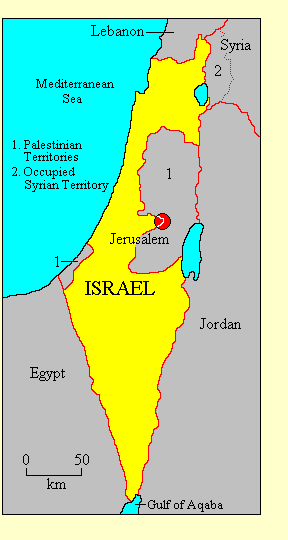
• Borders: Egypt, Jordan, Lebanon, Palestinian Territories, Syria
• Coastline: Gulf of Aqaba, Mediterranean Sea
• Land area: 20,770 Km2 (1967 borders)
• Population: 7,500,000 (this figure includes 470,000 Israeli settlers in Palestinian territories including East Jerusalem)
• Annual GDP (PPP) per capita: US$28,400 (2009 CIA estimate). World ranking: 35
• Ethnicity: Jewish 75%, Arab 21%, others 4%.
• Languages: Hebrew is the official language and is used by most of
the Jewish population. Arabic has official status in matters relating
to the Arab minority. Russian, Yiddish and Polish are spoken among the Jewish
population. English is widely used in business and media.
• Religion: Judaism is the state religion and is the
religion of 80% of the population. Other religions have freedom of worship. The Arab minority is divided between
Sunni Moslems (15%) and Christians of various denominations (5%).
• Form of government: Parliamentary democratic republic. Israel
is divided into six districts.
• Capital: Jerusalem (Yerushalayim, or al-Quds in Arabic)
• Constitution: Israel has no formal constitution. The system of government is
defined in series of Basic Laws.
• Head of state: The President, chosen by the legislature for a
seven-year term. The President's functions are largely ceremonial. President
Shimon Peres took office on 15 July 2007.
• Head of government: The Prime Minister, appointed by the President. The Prime
Minister is the leader of the majority coalition in the legislature and is accountable to it.
• Legislature: Israel has a unicameral legislature. The
Parliament (Knesset) has 120 members, elected
for four-year terms by proportional representation.
• Electoral authority: The government administers national elections.
r>• Freedom House 2011 rating: Political Rights 1, Civil Liberties 2
• Transparency International Corruption Index: 61% (30 of 178 countries rated)
• Reporters Without Borders Press Freedom 2010 Index: 73.7% (86 of 178 countries rated)
• Heritage Foundation Economic Freedom 2010 Index: 68.5% (43 of 178 countries rated)
Political history
The territory which is now Israel was part of the Ottoman province of Syria
from 1516 until 1917, when it was occupied by the British army during the First World
War. In 1923 it became a League of Nations mandated territory under British
administration, to which the British gave the name of the Roman province of Palestine. During the war the British had
promised the
Arab lands of the Ottoman Empire independence, but they had also made a statement (the Balfour
Declaration) in favour of a "Jewish national home" in Palestine, regarded by the Jews as their ancestral homeland.

As the persecution of Jews in
Europe worsened during the 1930s, pressure for Jewish immigration to Palestine increased,
despite resistance from the Arab majority in the territory. After the Second World War the murder of 6
million European Jews by the Nazi regime aroused international sentiment in favour of a Jewish state. When the British
banned further Jewish immigration,
Zionist militias launched a terrorist campaign against the British. In 1947 the British
handed the issue to the United Nations, which recommended that Palestine be partitioned
into a Jewish state and an Arab state. The Jewish organisations accepted the Partition Plan, but the Arabs,
supported by the Arab states, rejected it, and war broke out immediately. The State of Israel was declared in May 1948.
The victorious Israelis kept the lands seized during the war, and in 1967
also seized the West Bank from Jordan, the Golan Heights from Syria, and Gaza and the
Sinai from Egypt. Sinai was returned in 1979 as part of a peace treaty with Egypt, but
the other territories remain under Israeli occupation, and have in part been colonised by Israelis.
Israeli politics has been dominated by the issue of a settlement with the Palestinians since the 1970s.
The conservative Consolidation (Likud) of the
current Prime Minister, Binyamin Netanyahu, opposes concessions.
The Labour Party (Avoda), which governed Israel from
independence until 1977, in theory favours renewed negotiations and further concessions, but its current leader,
former Prime Minister Ehud Barak, is currently Netanyahu's Defence Minister since Likud and Labour are in coalition. Likud is
supported by Shas (a party of observant Sephardic Jews), and
Our Home Israel (Yisrael Beiteinu), a right-wing party supported by Russian immigrants.
The opposition consists mainly of
Forward (Kadima), now led by former Foreign Minister Tzipi Livni.
Freedom House's 2011
report on Israel
says: "Israel is an electoral democracy... At under 3 percent, Israel's vote threshold for a party to win parliamentary
representation is the world's lowest, leading to the regular formation of niche parties and unstable coalitions.
Parties or candidates that deny the existence of Israel as a Jewish state, oppose the democratic system, or incite
racism are prohibited... Corruption scandals in recent years have implicated senior officials including a prime minister,
a foreign minister, a finance minister, and the heads of the tax authority and the police... Press freedom is respected in
Israel, and the media are vibrant and independent. All Israeli newspapers are privately owned and freely criticise
government policy... While Israel's founding documents define it as a "Jewish and democratic state,"
freedom of religion is respected... Freedoms of assembly and association are respected. Israel hosts an active civil society,
and demonstrations are widely permitted... The judiciary is independent and regularly rules against the government."
Updated November 2011
|