
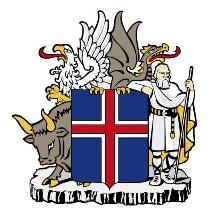
REPUBLIC OF ICELAND
• Official name: Lydhveldidh Island (Republic of Iceland)
• Location: Northern Europe / Atlantic Ocean
• International organisations: Council of Europe, North Atlantic Treaty Organisation, Organisation for
Economic Co-operation and Development, Organisation for Security and Co-operation in Europe,
United Nations, World Trade Organisation.
• Borders: None
• Coastline: Atlantic Ocean
• Land area: 103,000 Km2
• Population: 320,000
• Annual GDP (PPP) per capita: US$39,600 (2009 CIA estimate). World ranking: 14
• Ethnicity: Over 95% of the population are Icelandic. There are small minorities of other Europeans.
• Languages: Icelandic is the official language and is universally spoken. English, Danish and German are widely
understood.
• Religion: Almost the entire population are at least nominal Protestant Christians.
• Form of government: Parliamentary democratic republic. Ideland is divided into eight regions.
• Capital: Reykjavik
• Constitution: The Constitution of the Republic of Iceland came
into effect on 17 June 1944.
• Head of state: The President, elected by the direct universal suffrage for a four-year term. The
President's functions are largely ceremonial. President
Olafur Ragnar Grimsson
took office on 1 Aug 1996.
• Head of government: The Prime Minister, appointed by the President. The Prime Minister is the leader of the
largest party in the legislature and is accountable to it.
• Legislature: Iceland has a unicameral legislature. The
Parliament (Althing) has 63 members, elected for four-year terms from multi-member constituencies.
• Electoral authority: The National Electoral Commission of Iceland
administers national elections.

• Freedom House 2011 rating: Political Rights 1, Civil Liberties 1
• Transparency International Corruption Index: 85% (11 of 178 countries rated)
• Reporters Without Borders Press Freedom 2010 Index: 100% (1 of 178 countries rated)
• Heritage Foundation Economic Freedom 2010 Index: 68.2% (44 of 178 countries rated)
Political history
Iceland was first settled by Scandinavian and Celtic immigrants during the 9th and 10th centuries. Its legislature, the
Althing, was founded in 930. It was brought under Danish rule in 1380. Limited internal self-government was granted in 1874.
Iceland became fully self-governing in 1918 as the Kingdom of Iceland in personal union with Denmark, with the
Althing having full control over domestic matters. When Denmark was occupied by Germany in 1940, the Allies occupied
Iceland to prevent German influence, and the country became fully independent in 1944.
Iceland has been a stable and prosperous democracy throughout its history. In 2008, however, unsound
banking practices following deregulation led to a complete collapse of the country's financial system, leaving the
country saddled with enormous debts. This crisis led to the fall of the conservative coalition government
which Geir Haarde, leader of the Independence Party, had led since 2006. At
elections in 2009, the Social
Democratic Alliance and the Left-Green Movement won a majority between them,
and the Alliance leader Johanna Sigurdardottir became
Prime Minister. The Liberal Party lost all its seats at the election while the
Progressive Party maintained its position.
Updated November 2011
|