REPUBLIC OF
GUINEA-BISSAU
• Official name: Republica da Guine-Bissau (Republic of Guinea-Bissau)
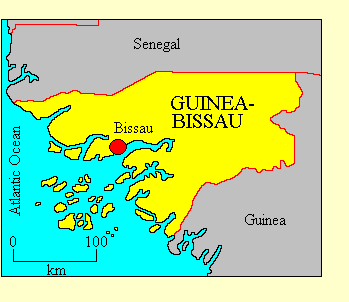
• Location: West Africa
• International organisations: African, Caribbean and Pacific Group of States, African Union, Non-Aligned
Movement, Organisation of Islamic Conference, United Nations, World Trade Organisation
• Borders: Guinea, Senegal
• Coastline: North Atlantic Ocean
• Land area: 36,120 Km2
• Population: 1,600,000
• Annual GDP (PPP) per capita: US$600 (2009 CIA estimate). World ranking: 189
• Ethnicity: Almost of the entire population is of West African stock. The largest
groups are the Balanta 30%, Fula 20%, Manjaca 14%, Mandinga 13% and Papel 7%.
• Languages: Portuguese is the official language and the language of government and business.
A Portuguese creole and African languages are spoken.
• Religion: Sunni Moslem 45%, Catholic Christian 5%, indigenous beliefs 50%.
• Form of government: Presidential republic. Guinea is divided into nine regions.
• Capital: Bissau
• Constitution: The
Constitution of the Republic of Guinea-Bissau came into effect on 16 May 1984.
• Head of state: According to the Constitution, the President, elected by direct universal suffrage for a
five-year term. Following the September 2003 coup the country has an interim president.
• Head of government: The Prime Minister, appointed by the President (currently by the interim president).
• Legislature: Guinea-Bissau has a unicameral legislature, the
National People's Assembly (Assembleia Nacional
Popular), which has 100 members elected for four-year terms.
• Electoral authority: The National Election Commission (CNE) administers elections.
• Freedom House 2009 rating: Political Rights 4, Civil Liberties 4
Political history
The coast of what is now Guinea-Bissau was explored and claimed by the Portuguese in 1446, but the Territory of
Portuguese Guinea was not established until 1630. Bissau was founded in 1765. Portuguese control of the interior
was not established until the 19th century. In 1952 the territory became an Overseas Province of Portugal. The
African Party for the Independence of Guinea and
Cape Verde (PAIGC) was organized by Amílcar Cabral and others in 1956, and armed resistance to
Portuguese rule escalated through the 1960s. When the Portuguese dictatorship was overthrown in April 1974,
Guinea-Bissau became independent with the PAIGC leader, Luis Cabral, as President.
Cabral was overthrown in a coup in 1980, and Joao Bernardo Vieira headed a military regime until
1984, when a new constitution was proclaimed establishing a one-party state. Vieira defeated several coup attempts before
finally being overthrown in 1999. In February 2000 Kumba Iala of the Social Renewal Party (PRS) was elected president in
Guinea-Bissau's first democractic presidential election. Legislative elections were repeatedly postponed, however, and Iala was
deposed in yet another coup in September 2003. In July 2005 Vieira returned to power when he was elected president as the
PRS candidate. Legislative elections were finally held in 2008, with the PAIGC winning the majority of seats.
Guinea-Bissau's chronic instability continued, however, when Vieira was assassinated in March 2009. Guinea-Bissau is one of
the world's poorest countries, and the presidential election was paid for international donors. At the election, held in June,
Malam Bacai Sanha of PAIGC was elected President, defeating the PRS candidate, former President Iala. Sanha died in
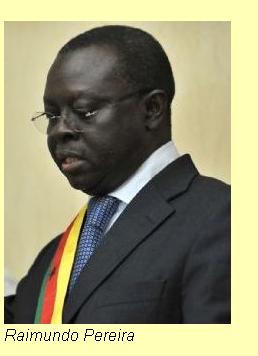
January 2012 and was succeeded by the President of the National People's Assembly,
Raimundo Pereira. Fresh presidential elections will be held in March.
Freedom House's 2009 report on Guinea-Bissau
(which was written before Vieira's assassination) says: "Guinea-Bissau is an electoral democracy... A national electoral commission
oversaw the 2005 presidential election, which international monitors agreed was free and fair. Observers lauded the 2008 legislative
elections, in which the opposition PAIGC won a large majority... In recent years, widespread corruption has reportedly helped
international drug cartels infiltrate the military, the civilian administration, and the judiciary. Guinea-Bissau ranked 158 out of
180 countries surveyed in Transparency International's 2008 Corruption Perceptions Index... The rights to assembly and association
are protected by law and generally respected by the authorities... Poor training, scant resources, and corruption seriously challenge
judicial independence."
Updated January 2012
|