
FEDERAL REPUBLIC
OF GERMANY
Official name: Bundesrepublik Deutschland (Federal Republic of Germany)
• Location: Central Europe
• International organisations: Council of Europe, European Union, Group of Eight, Group of Twenty, North Atlantic Treaty Organisation,
Organisation for Economic Co-operation and Development, Organisation for Security and Co-operation in Europe,
United Nations, Western European Union, World Trade Organisation
• Borders: Austria, Belgium, Czech Republic, Denmark, France, Luxembourg, Netherlands, Poland, Switzerland
• Coastline: Baltic Sea, North Sea
• Land area: 357,021 Km2
• Population: 82,100,000
• Annual GDP (PPP) per capita: US$34,100 (2009 CIA estimate). World ranking: 26
• Ethnicity: German 91.5%, Turkish 2.4%, other (various immigrant populations) 6.1%
• Languages: German is the official language and is almost univerally understood.
• Religion: Nominal Christian 68% (Lutheran Protestant 34%, Roman Catholic 34%), Sunni Moslem 3.7%,
no religion and other 28.3%
• Form of government: Federal parliamentary democratic republic.
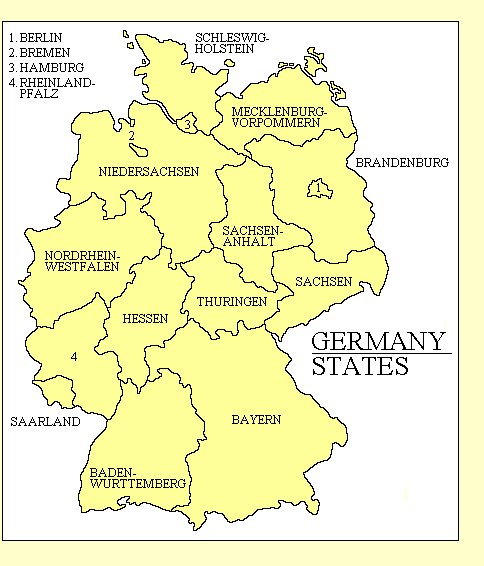
Germany is a federation of 16 states, which retain substantial legislative autonomy.
• Capital: Berlin
• Constitution: Germany's postwar constitution, the
Basic Law, came into effect on 23 May 1949.
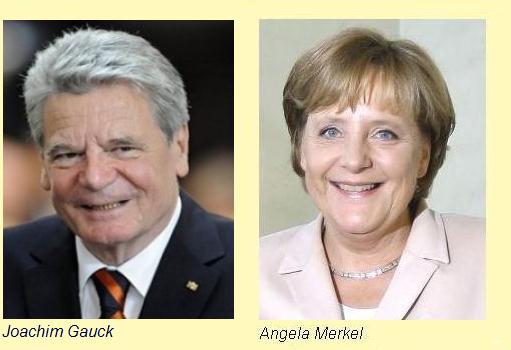
• Head of state: The President, elected by a Federal Convention
including all members of the national legislature and an equal number
of delegates elected by the state parliaments, for a five-year term.
The President's functions are mainly ceremonial. President
Joachim Gauck
took office on 18 March 2012.
• Head of government: The Federal Chancellor, appointed by the
President. The
Chancellor is usually the leader of the largest party or coalition of
parties in the legislature and is accountable to it.
• Legislature: Germany has a bicameral legislature. The
Federal Assembly
(Bundestag) has 603 members. Of these, 299 are elected from
single-member constituencies, and 304 are elected from party lists in
the states by proportional representation. The
Federal Council
(Bundesrat) has 69 members, who represent the governments of the states.
• Electoral authority: The
Federal Election Authority conducts federal and state elections.
• Freedom House 2011 rating: Political Rights 1, Civil Liberties 1
• Transparency International Corruption Index: 79% (15 of 178 countries rated)
• Reporters Without Borders Press Freedom 2010 Index: 94.7% (17 of 178 countries rated)
• Heritage Foundation Economic Freedom 2010 Index: 71.8% (23 of 179 countries rated)
Political history
After centuries of fragmentation, the majority of German-speaking
states (except Austria) were united under the leadership of Prussia in
the German Empire in 1871. The Empire had a national legislature, the
Reichstag, which was elected by universal male suffrage, but did not
have full control of the national government or the armed forces,
which remained accountable to the Emperor.
Following Germany's defeat in the World War I, the monarchy
was overthrown and a democratic republic was established, with the
Reichstag elected by universal franchise and a fully responsible
government. The Socialist leader Friedrich Ebert became President. But the
weakness of the parties committed to democracy, and the strength and mutual
antipathy of the Communist and National Socialist parties (particularly
after 1930) made it increasingly
difficult to form strong majority governments. This situation was
aggravated by the Depression. In January 1933 the Nazi leader Adolf
Hitler became Chancellor, and within months Germany succumbed to
dictatorship.
Germany's total defeat in the World War II resulted in the
abolition of German sovereignty and the country's division into four
zones of occupation. The Soviet Zone eventually became a Communist
state, the German Democratic Republic (DDR),
in 1949. The three western zones became the Federal Republic (BRD) in
the same year. Following the collapse of the Soviet system, the two
German states were re-united in October 1990 and German legal sovereignty was
restored. Postwar Germany has become a stable, prosperous and pacific
democracy. The disappearance of both Nazi and Communist ideological
parties has prevented the kind of instability which weakened the pre-war
German republic.
German politics is dominated by the
Social Democratic Party, a moderate
reformist party, and the two-party conservative alliance of the
Christian-Democratic Union and its
Bavarian ally the Christian Social Union. The SPD
is one of Europe's oldest parties, founded in 1890 by followers of Marx and Engels. It formally abandoned Marxism in 1957. The CDU-CSU was founded after the war to replace the old parties of the right,
which were discredited by their collaboration with Hitler.
Under Chancellor Konrad Adenauer the CDU-CSU held office for the
20 years after 1949, and under Helmut Kohl did so again from 1982 to
1998. The SPD held office under Willy Brandt and Helmut Schmidt in the 1970s, and
under Gerhard Schroeder from 1998 to 2005. After the deadlocked 2005 elections, the CDU-CSU and SPD formed a "grand
coalition" under the CDU's Angela Merkel. At the 2009 elections the SPD suffered a heavy defeat,
and Merkel was able to form a new government in coalition with the liberal, free-market
Free
Democratic Party (FDP). The left is now hamstrung by its division among the SPD, the
environmentalist Green Party, and
The Left, the successor to the East German
Communists.
Updated March 2012
|