GABONESE REPUBLIC
• Official name: Republique Gabonaise (Gabonese Republic)
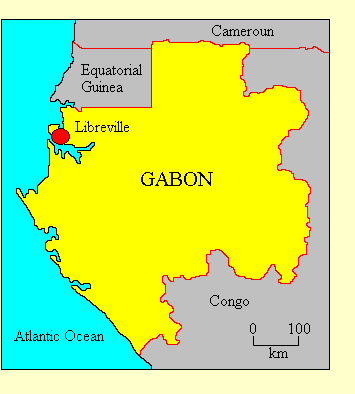
• Location: Central Africa
• International organisations: African, Caribbean and Pacific Group of States, African Union,
Non-Aligned Movement, Organisation Internationale de la Francophonie, United Nations, World Trade Organisation
• Borders: Cameroun, Congo Republic, Equatorial Guinea
• Coastline: South Atlantic Ocean
• Land area: 267,667 Km2
• Population: 1,500,000
• Annual GDP (PPP) per capita: US$13,900 (2009 CIA estimate). World ranking: 62
• Ethnicity: African peoples including the Fang, Bapounou, Nzebi and Obamba are the great majority of the
population. There is a small European minority.
• Languages: French is the official language, African languages spoken include Fang, Myene, Nzebi,
Bapounou and Bandjabi.
• Religion: About half the population are Catholic Christians. Most of the remainder follow indigenous
religions.
• Form of government: Presidential republic. Gabon is divided into nine provinces.
• Capital: Libreville
• Constitution: The
Constitution of the Gabonese Republic came into effect on 14 March 1991.
• Head of state: The President, elected by direct universal suffrage for a seven-year term.
• Head of government: The Prime Minister, appointed by the President. The Prime Minister is in practice
accountable to the President.
• Legislature: Gabon has a bicameral legislature. The National Assembly
(Assemblee Nationale) has 120 members
elected for five-year terms. The Senate (Senat) has 91, members elected by members of municipal councils and
provincial assemblies.
• Electoral authority: The Gabon Electoral Commission of the Ministry of the Interior administers national elections
• Freedom House 2011 rating: Political Rights 6, Civil Liberties 5
• Transparency International Corruption Index: 28% (110 of 178 countries rated)
• Reporters Without Borders Press Freedom 2010 Index: 71.2% (107 of 178 countries rated)
• Heritage Foundation Economic Freedom 2010 Index: 56.7% (110 of 178 countries rated)
Political history
The coast of what is now Gabon was explored by the Portuguese in the the late 15th century, but the first
European settlement was made by the French in 1839, and Libreville was founded as a settlement for freed slaves in
1849. In 1866 Gabon became part of French Congo, and in 1910 it was transferred to French Equatorial Africa. In 1946
it became a French overseas territory, and was granted full internal self-government in 1957. In August 1960 it
became an independent republic, although in practice France continued to exercise a strong influence, as it still
does.
The first president, Leon M'ba, was overthrown in a coup in 1964, but was restored by French troops. He
died in 1967, and was succeeded by his Vice-President, Albert-Bernard Bongo (known as Omar Bongo from 1973). Bongo established
a one-party state in 1968 and ruled as a dictator, albeit a relatively moderate one, until 1991, when a new constitution
establishing a multi-party system was approved. But Bongo and his Gabonese Democratic Party (PDG) remained dominant. At the 2001
legislative elections it won 88 of 120 seats in the National Assembly. In 2005 Bongo, by then the world's longest-ruling
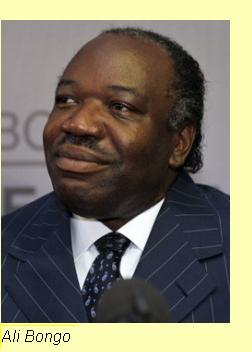
President, was easily elected to another term. He died in June 2009, and was succeeded by his son
Ali Bongo Ondimba, who won a presidential election in August
against a divided opposition. The main opposition party is the Union of the
Gabonese People.
Freedom House's 2011 report on Gabon
says: "Gabon is not an electoral democracy. The 2009 presidential election was marred by irregularities, including allegations
of vote rigging and intimidation of the press... Corruption is widespread. Rampant graft prevents the country’s significant
natural-resource revenue from benefiting most citizens... Press freedom is guaranteed by law but restricted in practice. The
state has the power to criminalize civil libel suits and, because legal cases against journalists are relatively common, many
reporters practice self-censorship... The rights of assembly and association are legally guaranteed but not always respected in
practice... The judiciary is not independent. Judges may deliver summary verdicts in some cases, and torture is sometimes
used to extract confessions. In addition, prosecutions of former government officials appear to target opposition
members."
Updated November 2011
|