REPUBLIC OF FINLAND
• Official name: Suomen Tasavalta / Republiken Finland (Republic of Finland)
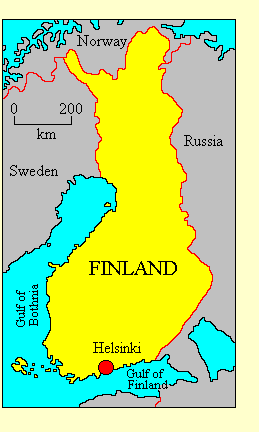
• Location: Northern Europe
• International organisations: Council of Europe, European Union, Organisation for Economic Co-operation
and Development, Organisation for Security and Co-operation in Europe, United Nations, Western European
Union, World Trade Organisation
• Borders: Norway, Russia, Sweden
• Coastline: Gulf of Bothnia, Gulf of Finland
• Land area: 337,030 Km2
• Population: 5,300,000
• Annual GDP (PPP) per capita: US$34,900 (2009 CIA estimate). World ranking: 25
• Ethnicity: Finnish 93%, Swedish 6%. There is a small Sami (Lapp) minority in the north.
• Languages: Finnish and Swedish are the official languages. There are small Sami and Russian-speaking
minorities.
• Religion: About 90% are at least nominally Protestant Christians, although the country
is increasingly secular. There are small Catholic and Orthodox Christian minorities.
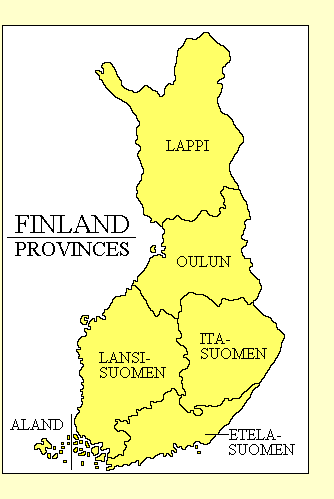
• Form of government: Parliamentary democratic republic. Finland is divided into six
provinces.
• Capital: Helsinki (Helsingfors in Swedish)
• Constitution: The
Constitution of the Republic of Finland came into effect on 17 July 1919. It was
substantially revised on 1 March 2000.
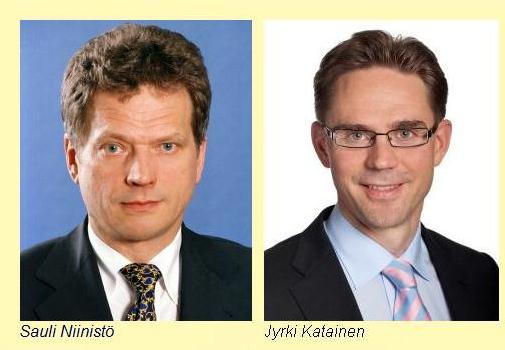
• Head of state: The President, elected by direct universal suffrage for a
six-year term. The President's functions are largely ceremonial. President
Sauli Niinisto took office on 1
March 2012.
• Head of government: The Prime Minister, appointed by the President. The Prime Minister is the
leader of the majority coalition in the legislature and is accountable to it.
• Legislature: Finland has a unicameral legislature. The
Parliament (Eduskunta / Riksdag) has 200
members, elected for four-year terms by proportional representation from multi-member constituencies.
• Electoral authority: The Ministry of Justice administers national elections
• Freedom House 2011 rating: Political Rights 1, Civil Liberties 1
• Transparency International Corruption Index: 92% (4 of 178 countries rated)
• Reporters Without Borders Press Freedom 2010 Index: 100% (1 of 178 countries rated)
• Heritage Foundation Economic Freedom 2010 Index: 74% (17 of 178 countries rated)
Political history
Finland was part of the Kingdom of Sweden until 1809, when it was ceded to Russia
during the Napoleonic Wars. Although Russian rule was fairly benign, a nationalist
movement arose in the later 19th century. The Finns joined the 1905 Russian revolution,
and the resultant repression inflamed national sentiment. When the communists seized power
in Russia in November 1917, Finland declared its independence. There was then a bitter civil war between the
Finnish communists and the anti-communist White Guards, ending in the victory of the latter.
During the 1920s Finland re-established domestic peace and became a stable
democracy. In 1939, however, Finland was invaded by the Soviet Union, and was forced to
agree to the loss of some territory in the 1940 peace treaty. Finland fought on the German
side in the Second World War and was lucky to escape Soviet occupation.
Since the war Finland has become one of Europe's most stable and progressive
democracies. The largest party on the right has usually been the moderate
Finnish Centre. The Finnish Christian-Democrats and the conservative
National Rally are also on the moderate right. The populist
True Finns are on the extreme right.
As in the other Scandinavian countries, the Social Democrats (SD) dominated
political life for most of the postwar period. It has been aided since the 1980s by the disappearance
of the once-powerful communist party. The left is now represented by the
Left Wing League and the
Green League. The Swedish People's Party represents
the Swedish minority.
The SD under Paavo
Lipponen was in office from 1995 to 2003. The 2003 election produced a deadlock, and the Centre Party
then formed a "grand coalition" with the SD, with the Centre's Matti Vanhanen as Prime Minister. The 2007 election
produced heavy losses for the SD, and Vanhanen then formed a coalition with the other right-wing
parties plus the Greens. Vanhanen retired in June 2010 and was succeeded as Centre leader and Prime
Minister by Mari Kiviniemi. The 2011 election saw a surge by the far-right, with the Centre being the biggest
loser. As a result, a new broad coalition was formed by Jyrki Katainen of
the National Rally.
Updated November 2011
|