
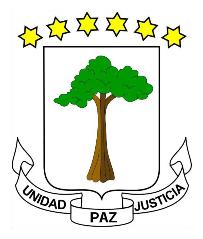
REPUBLIC OF EQUATORIAL GUINEA
• Official name: Republica de Guinea Ecuatorial (Republic of Equatorial Guinea)
• Location: Central Africa
• International organisations: African, Caribbean and Pacific Group of States, African Union, Non-Aligned Movement,
Organisation of Islamic Conference, United Nations
• Borders: Cameroun, Gabon
• Coastline: Bight of Biafra
• Land area: 28,051 Km2
• Population: 680,000
• Annual GDP (PPP) per capita: US$36,600 (2009 CIA estimate). World ranking: 21. On this index Equatorial
Guinea is by far the richest country in Africa, due to the country's new oil wealth. But very little of
this wealth has reached the population.
• Ethnicity: The largest ethnic groups are the Bubi and the Fang. There is a small European minority.
• Languages: Spanish is the official languages. African languages such as Fang, Bubi and Ibo as well as
local pidgins are spoken.
• Religion: Most of the population are at least nominal Catholic Christian, but indigenous beliefs are also
widely held.
• Form of government: Presidential republic, in practice a dictatorship. Equatorial Guinea is divided into
seven provinces
• Capital: Malabo
• Constitution: The
Constitution of the Republic of Equatorial Guinea came into effect on 1 September 1988.
• Head of state: The President, elected by direct universal suffrage for a seven-year term.
• Head of government: The Prime Minister, appointed by the President. The Prime Minister
is in theory accountable to the legislature but in practice is accountable to the President.
• Legislature: Equatorial Guinea has a unicameral legislature, the House of People's Representatives (Camara de
Representantes del Pueblo), which has 100 members elected for five-year terms from multi-member constituencies.
• Electoral authority: The Junta Electoral Nacional (National Election Council) administers elections.
• Freedom House 2009 rating: Political Rights 7, Civil Liberties 7 (Freedom House ranks Equatorial Guinea as one of the
world's eight most oppressive regimes.)
Political history
The Portuguese explorer Fernano do Po discovered the island of Bioko in 1471, and in 1778 Portugal ceded the
island to the Spanish who called in Fernando Poo. In 1844 Spain also claimed the neighbouring coastal area known
as Rio Muni. In 1904 the two territories were organised as Spanish Guinea. Since Spain itself was a dictatorship
from 1939, there was no constitutional development in the territory before it became independent as Equatorial
Guinea in October 1968. Francisco Macias Nguema took power and in July 1970 established a one-party state with
himself as President for Life. Macias soon became one of Africa's nastiest dictators. An estimated 50,000 people
were killed and a third of the population fled into exile.
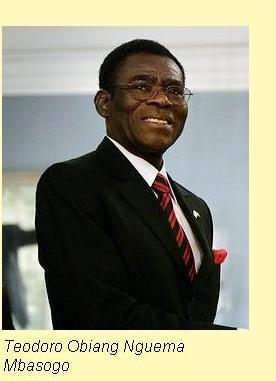
In August 1979 Macias's nephew,
Teodoro Obiang Nguema Mbasogo, seized power, and Macias was executed for
"treason." Despite promises of reform, Obiang continued authoritarian rule, although his regime was a great
improvement on his uncle's. A new constitution came into effect in 1982, and Obiang was elected President
without opposition. He has since been re-elected without opposition four times, most recently in November 2009.
One-party rule was formally abolished under a new
constitution in 1988, but Obiang's
Democratic Party of Equatorial Guinea (PDGE)
remains dominant.
The opposition
Convergence for a Social Democracy (CDS) boycotted the 2002 and 2009 presidential
elections. At the April 2004 legislative elections the CDS won only two seats. These elections were characterised
by massive vote-rigging by the ruling party and intimidation of the opposition. The opposition is believed to have
polled about 40% of the vote, but official figures have it only 6% (see Afrol News's
report).
Freedom House's 2009 report on Equatorial Guinea
says: "Equatorial Guinea is not an electoral democracy and has never held credible elections. President Teodoro Obiang Nguema
Mbasogo, whose current seven-year term will end in 2009, holds broad powers. The 100 members of the unicameral House of
People's Representatives are elected to five-year terms but wield little power, and 99 seats belong to the ruling
pro-presidential coalition. The activities of the few opposition parties, in particular the CDS, are closely monitored by
the government... Equatorial Guinea is considered one of the most corrupt countries in the world. Obiang and members of his
inner circle continue to amass huge personal profits from the oil windfall... Equatorial Guinea was ranked 171 out of 180
countries surveyed in Transparency International's 2008 Corruption Perceptions Index... The judiciary is not independent, and
security forces generally act with impunity."
Updated December 2009
|