CZECH REPUBLIC
• Official name: Ceska Republika (Czech Republic) (The name of the country in Czech is Cesky, but
for some reason this word is never used in English. It is usually translated as "the Czech Lands".)
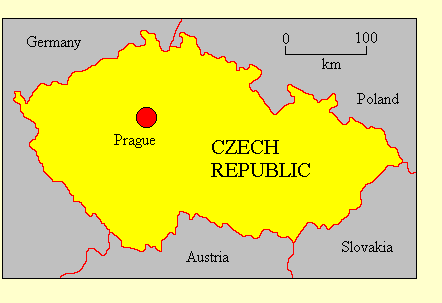
• Location: Central Europe
• International organisations: Council of Europe, European Union, North Atlantic Treaty Organisation,
Organisation for Economic Co-operation and Development, Organisation for Security and Co-operation in
Europe, United Nations, World Trade Organisation
• Borders: Austria, Germany, Poland, Slovakia
• Coastline: None
• Land area: 78,866 Km2
• Population: 10,500,000
• Annual GDP (PPP) per capita: US$25,100 (2009 CIA estimate). World ranking: 39
• Ethnicity: 95% of the population are Czechs, Moravians or Silesians. Although the
Constitution recognises these as three separate nationalities, there is no real difference between them.
The only significant minority are Slovaks (3.1%)
• Languages: Czech is the official language and is universally spoken.
• Religion: The Czech Republic is highly secularised. Less than 50% identify as Christian
(Catholic 39.2%, Protestant 4.6%, Orthodox 3%).
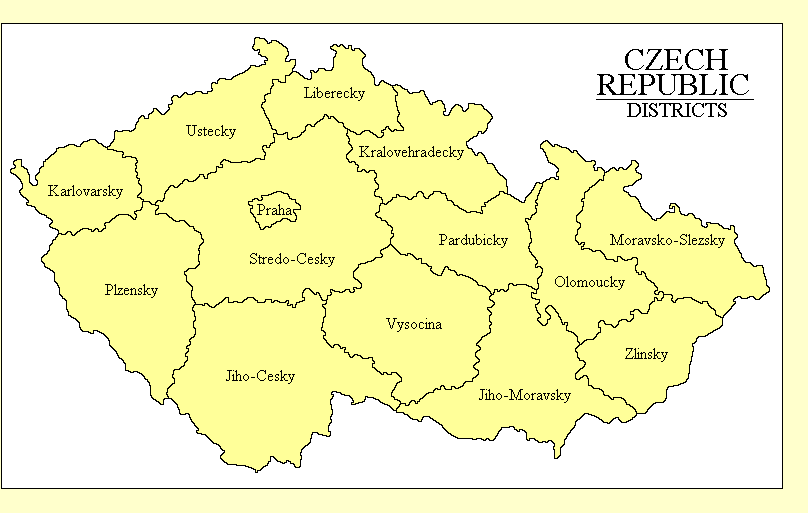
• Form of government: Parliamentary democratic republic. The Czech Republic is divided into
13 regions and the City of Prague
• Capital: Prague (Praha)
• Constitution: The Constitution of the Czech Republic came into effect on 16 December 1992.
• Head of state: The President, chosen by a joint sitting of the two houses of the
legislature for a five-year term. The President's functions are largely ceremonial. President
Vaclav Klaus assumed office on 7 March 2003.
• Head of government: The Prime Minister, appointed by the President. The Prime Minister is
the leader of the largest party or coalition in the legislature and is accountable to it.
• Legislature: The Czech Republic has a bicameral legislature, the Parliament of the Czech
Republic (Parlament Ceske Republiky). The Chamber
of Representatives (Poslanecka
Snimovna) has 200 members, elected for four-year terms by proportional representation.
The Senate (Senat) has 81 members, elected for six-year terms from single-member constituencies, with one-third being elected every two years.
• Electoral authority: The Central Election Commission administers national elections.
• Freedom House 2009 rating: Political Rights 1, Civil Liberties 1
Political history
The Kingdom of Bohemia, a largely German state, was absorbed into the Habsburg Empire in 1527.
The last attempt to reassert Bohemian independence was defeated in 1621. During the 19th century the
Slavic Czechs developed a distinct national consciousness, and in the 1890s a political movement for
Czech independence developed, led by Jan Masaryk. During the First World War Masaryk offered Czech
support to the Allies, and in 1918 when the Habsburg Empire collapsed a Czech and Slovak state was
proclaimed.

Czechoslovakia was in most respects a model democracy, but the Czech leaders foolishly insisted
that the new state should have the same borders as the Kingdom of Bohemia, which included 3 million
Germans. They then compounded this error by discrimination against the German minority. Thus when
Hitler's regime demanded the annexation of the German-speaking border areas (the Sudetenland) in 1938,
the Czechs were unable to resist. Germany occupied the rest of the country in 1939.
Democratic Czechoslovakia was reconstituted in 1945, minus the Germans who were all expelled.
But in 1948 the powerful Communist Party staged a coup, and Czechoslovakia became a one-party Communist
state for the next 40 years. In 1968 a liberal Czech Communist leader, Alexander Dubcek, tried to
reform the system, provoking a Soviet invasion. Communist rule ended only in 1990, when it became clear
that the Soviets would no longer intervene.
The "velvet revolution" of 1990 was followed by the "velvet divorce" of 1992 when Slovakia
peacefully seceded. The Czech Republic has been the most successful of the former Soviet satellite
states in making the transition to a free market economy, thanks mainly to Vaclav Klaus, Prime Minister
1992-97, who rapidly privatised the economy and prepared the country for entry to the European Union in
2004.
The Czech Republic has a stable western-type party system. The free-market liberals of the
Civic Democratic Party (ODS) were in government from 1992 to 2002, in coalition
with the Christian and Democratic Union-Czechoslovak People's Party (KDU). The
moderate left-wing
Czech Social Democratic Party (CSSD) was in office from 2002 to 2006,
supported from outside the government by the
Communist Party of Bohemia and Moravia (KSCM).
The 2006 election produced a deadlock between the ODS and its allies (which included the
Green Party), and the
CSSD and KSCM, each bloc having 100 seats. After a prolonged deadlock the ODS was able to form a
government under Mirek Topolanek. Topolanek resigned after losing a confidence vote in May 2009. A non-party figure,
Jan Fischer, then formed a caretaker government until the June 2010 elections. At these elections, the
KDU and the Greens lost all their seats, and both the ODS and the CSSD lost ground. Two new right-wing
populist parties, TOP 90 and
Public Affairs (VV) held
the balance of power. After the elections the ODS leader Petr Necas
formed a coalition government.
Updated June 2010
|