REPUBLIC OF CYPRUS
• Official name: Kipriaki Demokratia, Kibris Cumhuriyeti (Republic of Cyprus)
• Location: Southern Europe
• International organisations: Council of Europe, European Union, Non-Aligned Movement, Organisation
for Security and Co-operation in Europe, United Nations, World Trade Organisation
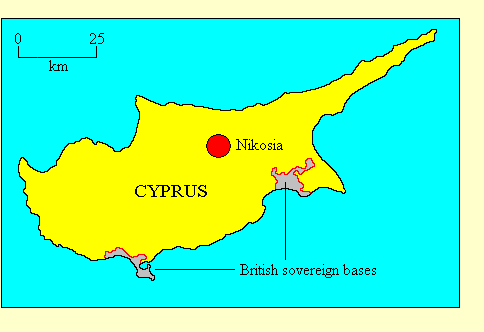
• Borders: British sovereign bases of Akrotiri and Dhekelia
• Coastline: Mediterranean Sea
• Land area: 5,895 Km2
• Population: 800,000
• Annual GDP (PPP) per capita: US$21,200 (2009 CIA estimate). World ranking: 45
• Ethnicity: Greek 77%, Turkish 18%, other 5%
• Languages: Greek and Turkish are the official languages. English is widely understood.
• Religion: Greek Orthodox Christian 77%, Suuni Muslim 18%, other Christian 5%.
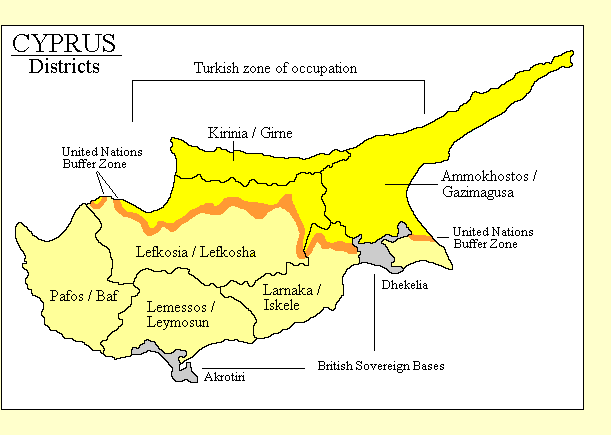
• Form of government: Presidential democratic republic. Cyprus is divided into six districts.
• Capital: Nikosia (Lefkosia, Lefkosa)
• Constitution: The Constitution of the Republic of
Cyprus came into
effect on 16 August 1960.
• Head of state: The President, elected by direct universal suffrage for a five-year term.
• Head of government: The President, who appoints the Cabinet.
• Legislature: Cyprus has a unicameral legislature, the House of Representatives
(Vouli ton Antiprosopon, Temsilciler Meclisi), which has 80 members elected for five-year terms from multi-member constituencies.
The 24 seats assigned to Turkish Cypriots are currently vacant. There are three non-voting members representing the
Armenian, Latin and Maronite minorities.
• Electoral authority: The Interior Ministry administers national elections.
• Freedom House rating 2009: Political Rights 1, Civil Liberties 1
Political history
Cyprus was part of the Ottoman Empire from 1570 until 1878, when it came under de facto British rule,
being formally annexed as a British Crown Colony in 1914. The Greek majority always believed that the island
should be united with Greece (although Greece declined a British offer to hand Cyprus over in 1915). Agitation for
unification (enosis) developed in the 1930s and 1940s, but met strong resistance from Turkey. From 1955
pro-enosis forces waged a terrorist campaign against Britain. After a prolonged crisis involving Britain,
Greece, Turkey and the UN, Cyprus became independent in 1960 under a formula that guaranteed Greek majority rule and
protected the rights of the Turkish minority. The Greek Orthodox Archbishop Makarios was elected President.

This compromise solution worked reasonably well until 1974, when the Greek military regime sponsored a
pro-enosis coup against Makarios. This provoked military intervention by Turkey, which occupied the northern
third of the island,
and has remained in occupation ever since. The Turkish Cypriots established the Turkish Republic of North Cyprus,
which is recognised only by Turkey. Numerous attempts to achieve reunification failed, mainly because the
Greek Cypriots would not agree to any plan which did not entail the withdrawal of Turkish forces from the island,
while the Turks insisted that their state be recognised.
In 2004 Cyprus joined the European Union, and the Turkish Cypriots began to change their minds about statehood when
they realised they would be excluded from the benefits of EU citizenship. The UN then proposed the Annan Plan for the
reunification of the island. In a referendum the Turks voted in favour, but the Greeks rejected the plan because it
not restore to them all the property in the north expropriated by Turkish settlers. The island thus remains divided.
The main Cypriot political parties are the left wing Progressive party for the
Working People (AKEL) and the conservative Democratic Alliance (DISI). At the
2006 legislative elections, AKEL and DISI won 18 seats each, while the Democratic Party (DIKO)won 11.
At the 2003 presidential election DIKO's Tassos Papadopooulos was elected with the support of AKEL on a platform of
opposition to concessions to the Turks. In 2008, however, AKEL
opposed his re-election, and he was eliminated in the first round. In the second round AKEL's
Dr Dimitris Christofias, a self-declared communist,
was elected.
Updated February 2010
|