REPUBLIC OF CUBA
• Official name: Republica de Cuba (Republic of Cuba)
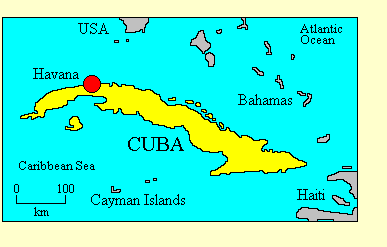
• Location: Caribbean
• International organisations: Non-Aligned Movement, Organisation of American States, United
Nations, World Trade Organisation
• Borders: None
• Coastline: Caribbean Sea, North Atlantic Ocean
• Land area: 110,860 Km2
• Population: 11,500,000
• Annual GDP (PPP) per capita: US$9,700 (2009 CIA estimate). World ranking: 86
• Ethnicity: About half the population are of mulatto (mixed European and African) descent. About
40% are of entirely European (mainly Spanish) descent, while 10% are of African descent.
• Languages: Spanish is the official language and is universally spoken.
• Religion: About 80% of the population are nominal Catholic Christians. The regime actively
discourages religious practice.
• Form of government: Communist dictatorship. Cuba is divided into 14 provinces and one special
administrative region.
• Capital: Havana (La Habana)
• Constitution: The Constitution of the
Republic of Cuba came into effect on 24 February 1976, and was last amended in July 1992.
• Head of state: The President, chosen elected by the National Assembly for a five-year term. The
last such election was in January 2008.
• Head of government: The President, who appoints all ministers.
• Legislature: Cuba has a unicameral legislature, the National Assembly
of People's Power (Asamblea Nacional de Poder Popular). This body has 601 members, elected for
five-year terms. The last elections were in January 2008. No candidates not approved by the Communist
Party were permitted. The legislature is in any case largely decorative.
• Electoral authority: Elections are conducted by the government.
• Freedom House 2011 rating: Political Rights 7, Civil Liberties 6
• Transparency International Corruption Index: 37% (69 of 178 countries rated)
• Reporters Without Borders Press Freedom 2010 Index: 12% (166 of 178 countries rated)
• Heritage Foundation Economic Freedom 2010 Index: 27.7% (177 of 179 countries rated)
Political history
Cuba became a Spanish possession when it was claimed by Columbus in 1492. Cuba did not become
independent in the 1820s along with the rest of Spanish America partly because of fear that the island
would be seized by the United States. An independence movement developed from the 1850s, but many
Cubans preferred Spanish rule to annexation by the USA, which seemed to be the alternative. A
revolution broke out in 1895, triggering the Spanish-American War and the American occupation of the
island. Full independence came only when the Americans withdrew in 1909.
Independent Cuba suffered from chronic bad government and corruption, as well as frequent
interference from the US. General Gerardo Machado, elected President in 1925, established a
dictatorship which lasted until 1933. President Ramon Grau San Martin (1944-48) tried to implement the
liberal reforms the country badly needed, but his successor Carlos Prio Socarras, elected at Cuba's
last free election in 1948, reverted to old corrupt ways. Fulgencio Batista seized power in 1952 and
established a dictatorship, which collaped in 1959 when rebel forces led by Fidel Castro seized power.
Castro came to power promising democracy and reform, but he soon aligned himself with the
Communists and by 1963 he had established a Communist dictatorship supported by the Soviet Union.
Although his anti-Americanism and many of his social reforms won him great popularity in Cuba and
beyond, his regime ruthlessly repressed those anyone calling for democracy or wider
personal freedoms. The Communist Party of Cuba is the only legal
political party.
The end of Soviet aid in 1991 created an economic crisis and a fall in living standards which
weakened the regime, but it survived, partly due to assistance from oil-rich Venezuela. In 2007
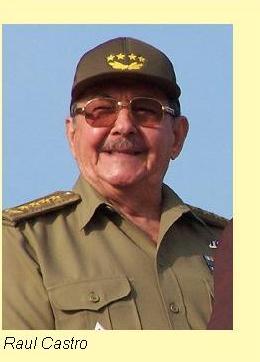
Castro's failing health forced him to retire as President, and he was succeeded without opposition by
his brother Raul Castro. The change was
followed by a slight political and economic liberalisation, but Fidel Castro remains
First Secretary of the Communist Party and a powerful influence against reform. The 2008 global financial
crisis hit Cuba hard and led to mass layoffs of state employees as the state's finances crumbled.
Raul Castro turned 80 in 2011 - what will happen when the Castros finally depart is unclear.
Freedom House's 2011
report on Cuba
says: "Cuba is not an electoral democracy. Longtime president Fidel Castro and his brother, current president
Raul Castro, dominate the one-party political system, in which the Communist Party of Cuba (PCC) controls all
government entities... All political organizing outside the PCC is illegal. Political dissent, whether spoken or
written, is a punishable offense, and dissidents frequently receive years of imprisonment for seemingly minor
infractions... Official corruption remains a serious problem, with a culture of illegality shrouding the mixture
of private and state-controlled economic activities that are allowed... The news media are controlled by the
state and the PCC... The government restricts academic freedom... The unauthorised assembly of more than three
people, even for religious services in private homes, is punishable with up to three months in prison and a
fine... The Council of State, led by Raul Castro, controls both the courts and the judicial process as a whole."
Updated November 2011
|