REPUBLIC OF
COTE D'IVOIRE
• Official name: Republique de Cote d'Ivoire (Republic of Cote d'Ivoire).
(The country was usually called Ivory Coast in English until 1985, when the government requested
that the French name be used.)
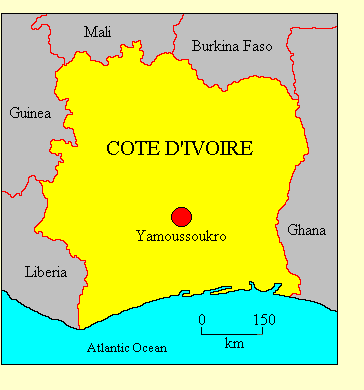
• Location: West Africa
• International organisations: African, Caribbean and Pacific Group of States, African Union, Non-Aligned
Movement, Organisation Internationale de la Francophonie, United Nations, World Trade Organisation
• Borders: Burkina Faso, Ghana, Guinea, Liberia, Mali
• Coastline: Gulf of Guinea
• Land area: 322,460 Km2
• Population: 20,600,000
• Annual GDP (PPP) per capita: US$1,700 (2009 CIA estimate). World ranking: 159
• Ethnicity: Virtually the entire population is of West African stock. The largest
groups are the Akan (42.1%), Gur (17.6%), Northern Mandes (16.5%), Krous (11%) and
Southern Mandes (10%). There are small Lebanese and French minorities.
• Languages: French is the official language and the language of business and the media. Many
African languages are spoken, corresponding to the ethnic groups listed above.
• Religion: Sunni Moslem 35-40%, Catholic Christian 20-30%, indigenous beliefs 25-40%
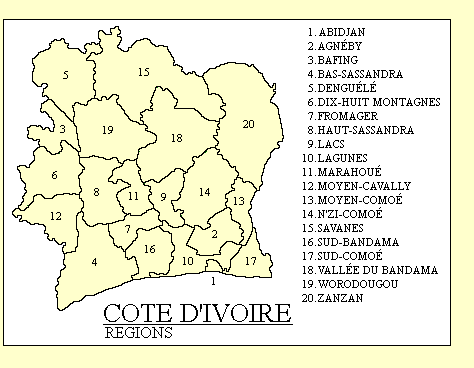
• Form of government: Presidential democratic republic. Cote d'Ivoire is divided into 20 regions and 58
Departments.
• Capital: Yamoussoukro (virtually all government functions remain at Abidjan, the
capital before 1983.)
• Constitution: The new Constitution of
Cote d'Ivoire came into effect on 23 July 2000.
• Head of state: The President, elected by direct universal suffrage for a five-year
term.
• Head of government: The Prime Minister, appointed by the President.
• Legislature: Cote d'Ivoire has a unicameral legislature. The
National Assembly (Assemblee Nationale)
has 225 members, elected for five-year terms from single-member constituencies.
• Electoral authority: The Independent Election
Commission (CEI) administers national elections.
• Freedom House 2011 rating: Political Rights 7, Civil Liberties 6
• Transparency International Corruption Index: 22% (146 of 178 countries rated)
• Reporters Without Borders Press Freedom 2010 Index: 64% (111 of 178 countries rated)
• Heritage Foundation Economic Freedom 2010 Index: 55.4% (122 of 178 countries rated)
These ratings related to the former Gbagbo regime.
Political history
The territory which now constitutes Cote d'Ivoire was mostly under the influence of
the Ashanti kingdom in neighbouring Ghana until the late 19th century. The French established trading
ports on the coast in 1843, but the territory was not formally annexed until 1893. Political
organisation of the population began after the Second World War, when
plantation workers led by Felix Houphouet-Boigny began to agitate against rule by white
coffee-planters.
An elected assembly was introduced in 1946, and universal suffrage in 1957. In 1958
Cote d'Ivoire voted for independence within the French Community, and full independence followed in 1960.
Houphouet-Boigny's
party, the Democratic Party of Cote d'Ivoire, dominated politics. The party was linked to
the French Communist Party until 1950, but by the time of independence Houphouet-Boigny had
become a reliable supporter of French interests.
Houphouet-Boigny established a one-party state and remained president with French
support until his death in December 1993, though as a fairly benevolent dictator by
African standards. He was succeeded by his deputy Henri Konan Bedie. Bedie was
overthrown in December 1999 by an army coup, and General Robert Guei took power.
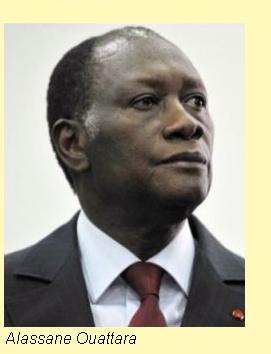
In 2000 Guei held presidential elections, but his main rival
Alassane Ouattara, a Moslem
from the north, was barred. The elections, however, were sufficiently
democratic for Guei to be defeated by his remaining rival, Laurent Gbagbo. After a period of tension
Guei accepted defeat and left the country. But Ouattara's supporters then launched a
rebellion that led the country into civil war.
In 2002 French peace-keepers arrived, and pressured Gbagbo into accepted a power-
sharing agreement with Ouattara's northern forces. This provoked anger in the Christian
south, and the French found themselves at the centre of the conflict rather than
impartial peace-keepers. A peace deal between Gbagbo and Outtara was brokered by the UN in 2007, but
the elections promised under this deal were repeatedly postponed. When presidential elections were finally held
in October and November 2910, Ouattara comfortably defeated Gbagbo. But Gbagbo refused to accept the results and a further
period of civil war continued until Gbagbo was defeated and captured. He is now facing trial at The Hague.
Before the collapse of the political order in 2002, Cote d'Ivoire's main political parties were
Gbagbo's social-democratic party, the Ivorian People's Front,
Houphouet-Boigny's old Democratic Party of Ivory Coast (PDCI) and Ouattara's
Rally of Republicans (RDR). Legislative elections were held in December 2011. These were
generally held to be free and fair, although Gbagbo's party boycotted the polls. The RDR swept the
northern regions and won just on half the seats nationwide. Turnout in the south was very low but the PDCI emerged as a
credible opposition.
Freedom House's 2011
report on Cote d'Ivoire
(which was written before the overthrow of President Gbagbo) says: "Cote d'Ivoire is not an electoral democracy...
However, the last legislative elections were held in 2000, and the 2010 presidential election degenerated into a
violent stalemate in which both runoff candidates - incumbent Laurent Gbagbo and challenger Alassane Ouattara -
declared themselves president. Former rebel leader Guillaume Soro, who was appointed to the position of prime minister
under the terms of the APO, resigned in December 2010 to protest Gbagbo's refusal to step down...
Corruption is a serious problem, and perpetrators rarely face prosecution or public exposure...
Despite constitutional protections, press freedomis generally not respected in practice. Violence against journalists
increased in the period surrounding the 2010 presidential election... The constitution protects the right to free assembly,
but it is often denied in practice... The judiciary is not independent. Judges are political appointees without tenure
and are highly susceptible to external interference and bribes. The Constitutional Council exhibited a remarkable
lack of independence in 2010 when it annulled the election results from the north and declared Gbagbo the winner,
despite endorsement of Ouattara's victory by the election commission and international observers."
Updated January 2012
|