DEMOCRATIC REPUBLIC OF CONGO
Official name: Republique Democratique du Congo (Democratic Republic of Congo)
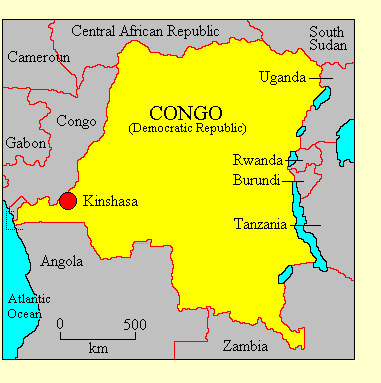
• Location: Central Africa
• International organisations: African, Caribbean and Pacific Group of States, African Union, Non-Aligned
Movement, Organisation Internationale de la Francophonie, United Nations, World Trade Organisation
• Borders: Angola, Burundi, Central African Republic, Republic of Congo, Rwanda, South Sudan, Tanzania, Uganda,
Zambia
• Coastline: South Atlantic Ocean
• Land area: 2,345,410 Km2
• Population: 66,000,000 (estimate)
• Annual GDP (PPP) per capita: US$300 (2009 CIA estimate). World ranking: 193. On this index the
Democratic Republic of Congo is the second-poorest country in the world.
• Ethnicity: Many African peoples live in Congo's enormous territory. The largest are the Mongo, Luba,
Kongo (all Bantu peoples), and the Mangbetu-Azande (Hamitic). There are large numbers of refugees from
Rwanda and other countries.
• Languages: French is the official language and the language of business and communications. Kingwana,
Kikongo and Tshiluba are the most widely used African languages.
• Religion: About half the population are nominal Catholic Christians, and about 10% are Moslem. Most of
the rest follow African animist religions.
• Form of government: In theory, a democratic presidential republic. In practice
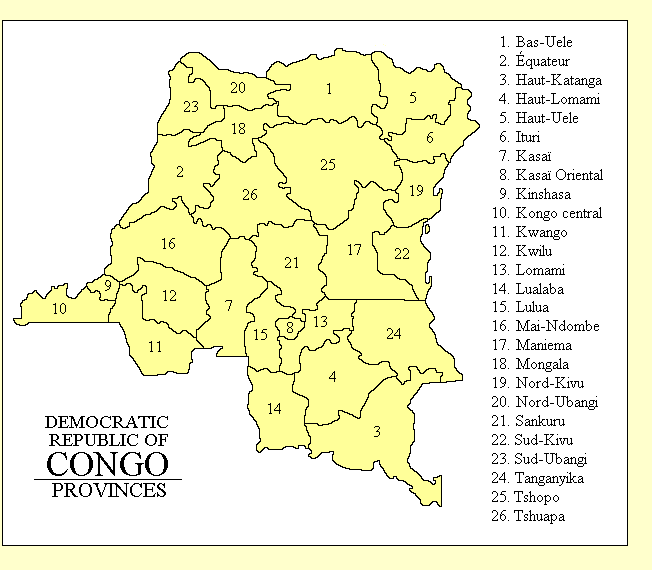
large parts of the country are beyond the government's control. Congo is divided into 26 provinces.
• Capital: Kinshasa
• Constitution: The Constitution of the Democratic
Republic of Congo came into effect on 8 February 2006.
• Head of state: The President, elected by the people for a five-year term.
• Head of government: The Prime Minister (a new position created by the 2006 constitution), appointed by
the President. In theory the Prime Minister is accountable to the National Assembly,
but in practice he is accountable to the President.
• Legislature: The Parliament of the Democratic Republic of Congo consists of two chambers,
the National Assembly (Assemblee Nationale) and the Senate (Senat). The National Assembly consists of 500 members elected by proportional representation from multi-member constituencies, for a five-year term. The Senate consists of 128 members indirectly elected by the provincial assemblies for a five-year term.
• Electoral authority: The Independent Election Commission administers national elections.
Note: Since the 2006 elections, all Congolese government websites appear to have gone offline.
• Freedom House 2011 rating: Political Rights 6, Civil Liberties 6
• Transparency International Corruption Index: 20% (164 of 178 countries rated)
• Reporters Without Borders Press Freedom 2010 Index: 48.2% (148 of 178 countries rated)
• Heritage Foundation Economic Freedom 2010 Index: 40.7% (172 of 178 countries rated)
Political history
The basin of the Congo River, a territory with no ethnic, linguistic or economic unity, was
declared to be a political entity under the sovereignty of the King of Belgium in 1885. King Leopold's
agents looted the territory with appalling cruelty, creating such a scandal that the Belgian government
assumed responsibility in 1908. Little was done to develop the area, however, and it was completely
unprepared for independence when the Belgians suddenly departed in 1960.
Joseph Kasavubu and Patrice Lumumba, the first leaders of independent Congo, were soon overthrown and
the country dissolved into civil war. From this chaos emerged the dictator Joseph-Desire Mobutu
(from 1972 styled Mobutu Sese Seko), who held power in Kinshasa from 1965 to 1997. One of Africa's most
corrupt rulers, Mobutu exercised only sporadic control over most of the country. From 1971 to 1997 the
country was called Zaire.
Mobutu was finally overthrown in 1997 by a rebel army led by Laurent-Desire Kabila, who soon
proved to be as autocratic, if not quite as corrupt, as his predecessor, and promised elections which were
never held. Kabila was assassinated in January 2001 and succeeded by his son Joseph Kabila. Various
foreign private armies, backed by governments seeking a share of Congo's vast untapped resources,
took control over parts of the east and south of the country, and ethnic violence broke out in many
places.
Following years of effort by the United Nations, a new constitution was approved by
referendum in 2005 and elections were held in August 2006, the first since 1960. Kabila was elected
President and his People's Party for Reconstruction and Democracy (PPRD)
(website offline) became the
largest party in the legislature. But Congo did not become a functioning democracy. Fighting soon broke
out between followers of Kabila and his defeated rival Jean-Pierre Bemba, leader of the
Movement for the Liberation of Congo (MLC). The ethnic violence in the east of the country has escalated.
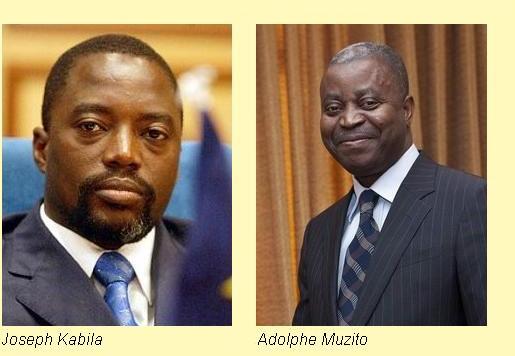
Kabila's first Prime Minister, Antoine Gizenga, resigned in 2008. He was succeeded by
Adolphe Muzito. The main opposition party is now the
Union for Democracy and Social Progress, whose leader Dr Etienne Tshisekedi wa Mulumba is
the main opposition candidate at the November presidential election.
The UN mission in Congo has information at
the MONUC website.
Freedom House's 2011
report on Democratic Republic of Congo
says: "The DRC is not an electoral democracy. The 2006 elections were a significant improvement over
previous elections, but serious problems remained. The opposition Union for Social Democracy and
Progress (UDPS) party did not participate as a result of the party leader's call for a boycott of the
recent constitutional referendum. International observers noted voter registration irregularities and
corruption... In August 2010, the outgoing Independent Electoral
Commission (CEI) announced a timetable for new elections, with the first round of the presidential vote slated for
November 2011... However, it remained unclear whether the new Independent National Electoral Commission (CENI) — created
by President Laurent-Desire Kabila in July — would respect the timetable. The CENI's potential for independence has
also been called into question, as four of its seven members were to be appointed by the presidential coalition...
Opposition politicians and their supporters have increasingly faced violence and harassment. On a number of occasions in
2010, police beat or arrested members of the UDPS who engaged in unauthorised protests...
Corruption is rampant in the DRC, particularly in the mining sector... Corruption is rampant in the DRC, particularly in the
mining sector... Although guaranteed by the constitution, freedoms of speech and expression are limited. Members of the
state security apparatus threatened, detained, and attacked journalists whose reporting was critical of government
officials... The rights to freedom of assembly and association are limited under the pretext of maintaining public order...
Despite constitutional guarantees of independence, the judiciary remains subject to corruption and manipulation, and the
court system lacks both trained personnel and resources."
Updated November 2011
|