REPUBLIC OF CHAD
• Official name: Republique du Tchad / al-Jumhuriya al-Tashad (Republic of Chad)
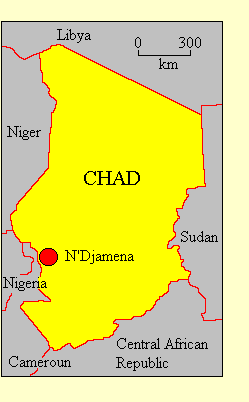
• Location: Central Africa
• International organisations: African, Caribbean and Pacific Group of States, African Union, Non-Aligned
Movement, Organisation Internationale de la Francophonie, Organisation of Islamic Conference, United
Nations, World Trade Organisation
• Borders: Cameroun, Central African Republic, Libya, Niger, Nigeria, Sudan
• Coastline: None
• Land area: 1,284,000 Km2
• Population: 11,200,000
• Annual GDP (PPP) per capita: US$1,600 (2009 CIA estimate). World ranking: 160
• Ethnicity: Chad is divided between the north, whose people are a mix of Arab and
Berber stock, and the south, whose people are of Sudanic African stock. The largest
ethnic group are the Sara in the south.
• Languages: French and Arabic are the official languages. About 15% speak Arabic
as their first language. Many African languages are spoken, the largest
being Fulfulde, Sango, Ngambe, Kanembu, Maba and Dazaga.
• Religion: Sunni Moslem 51%, Catholic Christian 35%, indigenous beliefs 14%
• Form of government: Presidential republic. Chad is divided into 14 prefectures.
• Capital: N'Djamena
• Constitution: The new
Constitution of the Republic of Chad came
into effect on 13 March 1996.
• Head of state: The President, elected by direct universal suffrage for a five-year term.
• Head of government: The Prime Minister, appointed by the President. The Prime Minister
is the leader of the largest party in the legislature and is accountable to it.
• Legislature: Chad has a bicameral legislature. The National Assembly (Assemblee
Nationale) has 155 members, elected for four-year terms from a mixture of multi-mmeber
and single-member constituencies. The Senate is elected by an
electoral college representing regional and municipal authorities.
• Electoral authority: The Independent National Election Commission (CENI) administers national elections.
• Freedom House 2011 rating: Political Rights 7, Civil Liberties 6
• Transparency International Corruption Index: 17% (171 of 178 countries rated)
• Reporters Without Borders Press Freedom 2010 Index: 66.8% (112 of 178 countries rated)
• Heritage Foundation Economic Freedom 2010 Index: 45.3% (165 of 179 countries rated)
Political history
The area which is now Chad was brought under French control in the 1890s and
became part of French Equatorial Africa in 1910, administered from Brazzaville in the
Congo. Chad became a separate colony in 1946. It was one of the least developed of France's colonies when it became self-
governing within the French Community in 1958 and independent in 1960. It was also
weakened by the divide between the Moslem-Arab north and the Christian-African south.
It was not surprising therefore that democratic government was not established
in independent Chad. Francois Tombalbaye soon established himself as a dictator and
ruled until his assassination in 1975. Moslem resentment at his rule led to an
insurrection in the north which continued on and off through the 1970s. Following Tombalbaye's death a
northerner, Goukouni Oueddei, seized power and
ruled with the support of Libyan troops until 1982, when he was overthrown by
forces led by Hissene Habre.
Fighting continued until 1987, when there was a ceasefire.
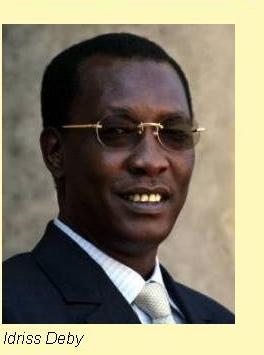
In 1990 Habre, who had become a very oppressive ruler, was in turn overthrown by
Idriss Deby's Movement for Popular Salvation.
In 1996 a new constitution was drafted and a multi-party system established, at least
in theory. President Deby's Patriotic
Salvation Movement (MSP) remains the dominant force in the country. The main opposition
parties are the Rally for Democracy and Progress and Federation Action for the Republic.
Since the presidential election in 2006, the situation in Chad has deteriorated, mainly because
of the continuing conflict in the neighbouring Darfur region of Sudan, which has caused hundreds of thousands of
Sudanese refugees to flood into Chad, and has also led to Sudanese allegations that Chad is harbouring Darfuri
insurgents. Several rebellions and insurgencies have broken out. In response, President Deby has cracked down on
opposition and now rules as a virtual dictator. The legislative elections scheduled for 2007 were
finally held in February 2011, and as expected produced a large majority for Deby's party. Deby himself was
re-elected without serious opposition in April 2011.
Freedom House's 2011 report on
Chad says: "Chad is not an electoral democracy. The country has never experienced a free and fair transfer of
power through elections. The president is elected for five-year terms, and a 2005 constitutional amendment
abolished term limits. The 2006 presidential election was held shortly after a rebel assault on the capital
despite calls for a postponement. Many opposition members boycotted the balloting, which was reportedly marred by
irregularities, and voter turnout may have been as low as 10 percent in some areas. The executive branch dominates
the judicial and legislative branches... Corruption is rampant within Deby's inner circle.Weaknesses in revenue
management and oversight facilitate the diversion of oil revenues from national development projects to private
interests and growing military expenditures... Freedom of expression is severely restricted, and self-censorship
is common... Although Chad is a secular state, religion is a divisive force. Muslims, who make up slightly more
than half of the population, hold a disproportionately large number of senior government posts, and some policies
favor Islam in practice... Despite the constitutional guarantee of free assembly, the authorities ban
demonstrations by groups thought to be critical of the government... The rule of law and the judicial system
remain weak, with courts heavily influenced by the political leadership. Civilian leaders do not maintain
effective control of the security forces, which routinely ignore constitutional protections regarding search,
seizure, and detention."
Updated November 2011
|