CENTRAL AFRICAN REPUBLIC
• Official name: Republique Centrafricaine (Central African Republic)
• Location: Central Africa
• International organisations: African, Caribbean and Pacific Group of States, African Union, Non-Aligned
Movement, International Francophone Organisation, United Nations, World Trade Organisation
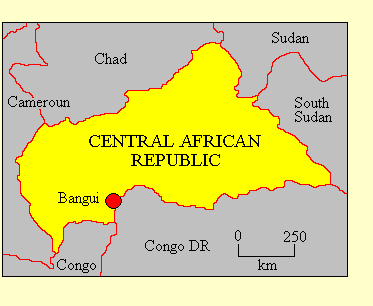
• Borders: Cameroun, Chad, Congo (Democratic Republic), Congo (Republic), South Sudan, Sudan
• Coastline: None
• Land area: 622,984 Km2
• Population: 4,400,000
• Annual GDP (PPP) per capita: US$700 (2009 CIA estimate). World ranking: 186
• Ethnicity: Virtually the entire population is of Sudanic African stock. The largest
ethnic groups are the Baya (33%), Banda (27%), Mandjia (13%), Sara
(10%), Mboum (7%), M'Baka (4%) and Yakoma (4%).
• Languages: French is the official language and is the language of government and business.
The main African languages are Gbaya (20%), Banda (20%), Sangho (10%), Manza (8%), Yakoma (3%).
• Religion: Christian 50% (Protestant 25%, Catholic 25%),
indigenous beliefs 35%, Sunni Moslem 15%.
• Form of government: Presidential republic. The Central African Republic is
divided into 16 prefectures and the commune of the national capital.
• Capital: Bangui
• Constitution: The
Constitution of the Central African Republic came into effect on 7 January 1995.
• Head of state: The President, elected by direct universal suffrage for a six-year term.
• Head of government: The Prime Minister, appointed by the President.
• Legislature: The Central African Republic has a unicameral
legislature, the National
Assembly (Assemblee Nationale). The Assembly has 109 members and is elected for five-year terms.
• Electoral authority: The Independent National Election Commission conducts national elections.
• Freedom House 2011 rating: Political Rights 5, Civil Liberties 5
• Transparency International Corruption Index: 21% (154 of 178 countries rated)
• Reporters Without Borders Press Freedom 2010 Index: 81.5% (69 of 178 countries rated)
• Heritage Foundation Economic Freedom 2010 Index: 49.3% (152 of 179 countries rated)
Political history
The area which is now the Central African Republic was under the nominal sovereignty of
the Ottoman province of Egypt until the late 19th century, when it was penetrated by the
French, who formally annexed it as the colony of Ubangi-Chari in 1894. In 1910
it became part of French Equatorial Africa. In 1946 it again became a separate colony, and in
1958 it became self-governing within the French Community. Full independence as the
Central African Republic followed in August 1960.

The founding President, David Dacko, was overthrown in a coup in 1966 by Colonel Jean-Bedel
Bokassa, who ruled as an increasingly oppressive dictator, declaring himself "Emperor"
in 1976. In 1979 he was removed by a French-backed coup and Dacko was restored to power. Dacko's
efforts to establish a democratic government were unsuccessful, and in 1981, he was
again overthrown in coup by General Andre Kolingba. From 1985 onwards Kolingba oversaw a gradual
restoration of constitutional government, and a multi-party system was established in 1991.
In 1993 Ange Felix Patasse was elected President, and he was re-elected in 1999. Ethnic tensions and
economic difficulties led to three attempted coups in 1996 and 1997,
which were suppressed with French aid and an African peacekeeping force. But in March 2003
army rebels overthrew Patasse and installed their commander, General
Francois Bozize, as President. Presidential
and legislative elections were held in early 2005, confirming and legitimising Bozize's hold on power.
The country continues to be plagued by insurgencies, partly as a result of its proximity to the strife-torn
Darfur region of Sudan.
The dominant party is now President Bozize's National Convergence "Kwa Na Kwa" (KNK), which won a plurality
in the National Assembly in 2005 and has the support of minor groups. The main opposition party the
Movement for the Liberation of the Central African People (MLPC), which supports former President Patasse.
Bozize comfortably defeated Patasse at presidential elections in February 2011, and his party retained
control of the legislature.
Freedom House's 2011 report
on the Central African Republic (which was written before the 2011 election) says: "The CAR is not an
electoral democracy. The 2005 presidential and parliamentary elections were marked by some irregularities and
criticised by opposition candidates as unfair. The president appoints the cabinet and dominates the
legislative and judicial branches... Corruption remains pervasive, despite some steps toward reform in recent
years... The government generally respects the right to free speech, but many journalists practice
self-censorship... Freedoms of assembly and association are constitutionally protected and generally upheld
in practice... Corruption, political interference, and lack of training undermine the judiciary. Judges are
appointed by the president, and proceedings are prone to executive influence."
Updated November 2011
|