REPUBLIC OF BURUNDI
• Official name: Republika y'u Burundi / Republique du Burundi (Republic of Burundi)
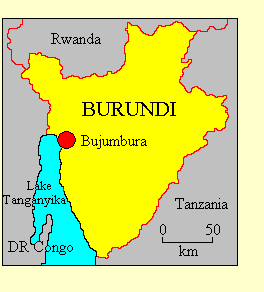
• Location: Central Africa
• International organisations: African, Caribbean and Pacific Group of States, African Union, Organisation
Internationale de la Francophonie, United Nations, World Trade Organisation
• Borders: Congo (Democratic Republic), Rwanda, Tanzania
• Coastline: None
• Land area: 27,830 Km2
• Population: 8,300,000
• Annual GDP (PPP) per capita: US$300 (2009 CIA estimate). World ranking: 192. On this index
Burundi is the third-poorest country in the world.
• Ethnicity: Almost the entire population is of African stock, the largest ethnic groups
being the Hutu (85%) and the Tutsi (14%).
• Languages: Kirundi and French are the official languages. French is the language of
government, business and the media. Swahili is also spoken.
• Religion: Christian 67% (Catholic 62%, Protestant 5%), indigenous beliefs 23%, Sunni
Moslem 10%
• Form of government: Democratic presidential republic. Burundi is divided into 16
provinces
• Capital: Bujumbura
• Constitution: The new
Constitution of the Republic of Burundi came into effect in February 2005.
• Head of state: The President is chosen by the National Assenbly. There are two vice-presidents, one of whom must be a Tutsi.
• Head of government: The President, who appoints all ministers.
• Legislature: The National Assembly (Assemblee Nationale) (no website) has 118 members, of whom 100 are elected for
five-year terms by proportional representation and 18 are co-opted. The Senate has 49 members, and must include equal
numbers of Hutu and Tutsi, plus representatives of minor ethnic groups.
• Electoral authority: Elections are run by the National Independent Electoral Commission (no website).
• Freedom House 2011 rating: Political Rights 5, Civil Liberties 5
• Transparency International Corruption Index: 18% (170 of 178 countries rated)
• Reporters Without Borders Press Freedom 2010 Index: 71.2% (108 of 178 countries rated)
• Heritage Foundation Economic Freedom 2010 Index: 49.6% (148 of 178 countries rated)
Political history
The territory which now constitutes Burundi and Rwanda was annexed to German East
Africa in 1890. In 1916 the territory was occupied by Belgians, and in 1922 the it was
made the League of Nations Mandate of Ruanda-Urundi under Belgian administration. This
became a United Nations Mandate in 1945. In the 1950s a nationalist movement developed,
and internal self-government was granted in 1960. In 1962 the territory was divided
into two independent republics, Burundi and Rwanda.

Before European occupation, Burundi had been ruled by the Tutsi minority, who
kept the Hutu majority in serfdom. After independence the Tutsi minority retained power
under the Tutsi monarchy. In 1966 a military coup led to the establishment of a republic,
but the Tutsis remained in control, first under Michel Micombero, then after another
coup in 1987, under Pierre Buyoya.
Buyoya attempted to reform the ethnic divisions in Burundi by giving more power
to the Hutu majority. In 1992 he introduced a new constitution which allowed a
multiparty political system. In the country's first free election in 1993 the Hutu
majority elected Melchior Ndadaye
as President, but he was soon overthrown in a Tutsi-led army coup. In 1994 another Hutu President,
Cyprien Ntaryamira, was assassinated.
He was succeeded by Sylvestre Ntibantunganya, but he was in turn overthrown in a coup led by
former President Buyoya
in July, 1996. Violence and ethnic
massacres in which about 200,000 people were killed accompanied these convulsions.
Following international mediation in 1998, Buyoya was recognised as
interim president and a transitional legislature created. In July 2001, the Arusha accords,
a Tutsi-Hutu power-sharing agreement,
were finalised.
In April 2003 Domitien Ndayizeye, a Hutu, succeeded Buyoya as interim president.
Free, fair and peaceful elections were held under a new constitution in 2005. Following these elections, the
National Assembly chose Pierre Nkurunziza as
President.
The dominant party in Burundi is President Nkurunziza's National Council for the Defense of Democracy, which
represents the Hutu majority. The main opposition parties are the leftist Front for
Democracy in Burundi and the Union for National Progress, which represents the Tutsi minority.
Freedom House's 2011 report on Burundi
says: "Burundi is not an electoral democracy. The country lacks representative institutions at the
national level, in both the legislative and executive branches of government. Despite citizens'
ability to change their government democratically in 2005, serious electoral irregularities and
repression during the May 2010 local elections led most opposition parties to boycott subsequent
presidential and parliamentary polls. The 2010 presidential election was the first by direct vote
for a five-year term, but without meaningful competition, the results lacked legitimacy... Corruption
remains a significant problem... Freedom of speech is legally guaranteed. While journalists continue
to engage in self-censorship and are occasionally censored by authorities, they have been increasingly
willing to express opinions critical of the government... The constitution provides for freedoms of
assembly and association, although members of human rights groups that criticize the government have
been threatened with or subjected to surveillance... Burundi’s judiciary is hindered by corruption, a
lack of resources and training, and executive interference in legal matters."
Updated November 2011
|