KINGDOM OF BHUTAN
• Official name: 'Brug yul (Kingdom of Bhutan)
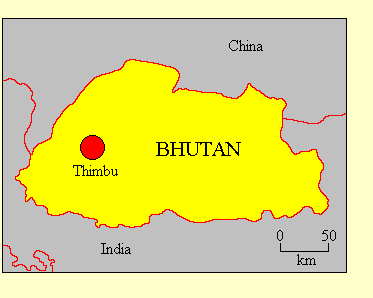
• Location: South Asia
• International organisations: Non-Aligned Movement, United Nations.
• Borders: China, India
• Coastline: None
• Land area: 47,000 Km2
• Population: 690,000
• Annual GDP (PPP) per capita: US$5,400 (2009 CIA estimate). World ranking: 111
• Ethnicity: Bhote or Bhutanese 50%, Nepalese 35%, various minority tribes 15%
• Languages: Dzongkha or Bhutanese is the official language but is spoken by less than half the population. A large minority speaks various forms of
Nepalese, and several other Tibeto-Burman and Indian languages are spoken.
• Religion: Lamaistic Buddhist 75%, Hindu 25%
• Form of government: Semi-constitutional monarchy. Bhutan is divided into 18 districts.
• Capital: Thimbu
• Constitution: None. The form of government is prescribed in various royal edicts.
• Head of state: King
Jigme Khesar Namgyel Wangchuck came to the throne on 14 December 2006.
• Head of government: The Prime Minister, appointed by the King.
• Legislature: Bhutan has a unicameral legislature, the National Assembly (Tshogdu)
which has 47 members elected from single-member constituencies for five-year terms.
• Electoral authority: Elections are organised by the Election Commission of Bhutan.
• Freedom House 2011 rating: Political Rights 4, Civil Liberties 5
• Transparency International Corruption Index: 57% (36 of 178 countries rated)
• Reporters Without Borders Press Freedom 2010 Index: 77.5% (64 of 178 countries rated)
• Heritage Foundation Economic Freedom 2010 Index: 57.6% (103 of 178 countries rated)
Political history
Bhutan has existed as a state since the 17th century, and was traditionally ruled by a Buddhist theocracy under Tibetan
influence. In 1907 a stable monarchy was established under the influence of British India, headed by the Wangchuk dynasty
who have occupied the throne ever since. In 1910 Bhutan became formally a British protectorate, and in 1947 independent India
succeeded the British in this role. In 1949 the protectorate was ended but under a treaty India continued to control Bhutan's
foreign relations.

From 1952 to 2008 the King retained control of Bhutan's government, although day to day affairs were in the hands of a
Prime Minister. King Jigme Singye Wangchuck, who succeeded to the throne in 1972, carried out a programme of
gradual modernisation while preserving Bhutanese traditions. The King abdicated in 2008, and his son Jigme Khesar Namgyel
Wangchuckcame legalised political parties and called Bhutan's first ever elections, which were held in March 2008.
Bhutan's two major parties are the Bhutan Peace and Prosperity Party (DPT),
led by Jigme Thinley, and the
People's Democratic Party (PDP). At the 2008 elections the DPT won 45 of the 47 seats in the
Assembly and Jigme Thinley become Prime Minister.
Freedom House's 2011 report on Bhutan
says: "Bhutan is not an electoral democracy, though the 2008 elections represented a significant step toward that status. An EU monitoring team
reported that the National Assembly elections 'generally met international standards,' though it found problems with freedom of expression and
association during the campaign... The government operates with limited transparency and accountability, but steps have been taken in recent
years to improve both... The authorities restrict freedom of expression, and a 1992 law prohibits criticism of the king and the political system...
The constitution guarantees freedom of assembly, but the government must approve the purpose of any protests... The constitution guarantees freedom
of association, but only for groups 'not harmful to the peace and unity of the country'... An independent Judicial Service Council created in 2007
controls judicial appointments and promotions. However, critics have alleged that the judiciary is not fully independent."
Updated October 2011
|