REPUBLIC OF BENIN
• Official name: Republique du Benin (Republic of Benin)
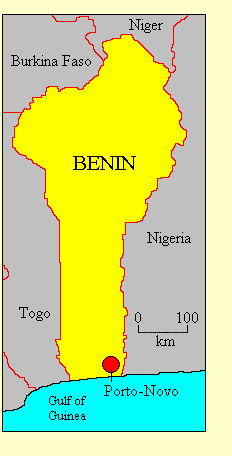
• Location: West Africa
• International organisations: African, Caribbean and Pacific Group of States, African Union,
Non-Aligned Movement, Organisation Internationale de la Francophonie, Organisation of Islamic
Conference, United Nations, World Trade Organisation
• Borders: Burkina Faso, Niger, Nigeria, Togo
• Coastline: Gulf of Guinea
• Land area: 112,620 Km2
• Population: 8,900,000
• Annual GDP (PPP) per capita: US$1,500 (2009 CIA estimate). World ranking: 165
• Ethnicity: Almost the entire population is of West African stock, the largest groups
being the Fon, the Yoruba and the Adja
• Languages: French is the official language and is the language of government, business
and the media. Many African languages are spoken, the most common being Fon and Yobuba.
• Religion: Indigenous beliefs 50%, Catholic Christian 30%, Sunni Moslem 20%
• Form of government: Presidential democratic republic. Benin is divided into 12
provinces.
• Capital: Porto-Novo (many government functions are based in Cotonou, the
commercial centre)
• Constitution: The
Constitution of the Republic of Benin came into effect in December 1990.
• Head of state: The President, elected by direct universal suffrage for a
five-year term.
• Head of government: The President, who appoints all ministers.
• Legislature: Benin has a unicameral legislature, the National Assembly
(Assemblee Nationale), which has 83 members elected for four-year terms by proportional representation.
• Electoral authority: The National Autonomous Election Commission (CENA) administers national elections.
• Freedom House 2011 rating: Political Rights 2, Civil Liberties 2
• Transparency International Corruption Index: 28% (110 of 178 countries rated)
• Reporters Without Borders Press Freedom 2010 Index: 81.0% (70 of 178 countries rated)
• Heritage Foundation Economic Freedom 2010 Index: 56.0% (117 of 178 countries rated)
Political history
Although Porto-Novo was founded by the Portuguese, the coastal areas of what is now
Benin came under French control in the 1850s, and Porto-Novo became a French protectorate
in 1863. The inland areas were added in the 1890s, with the colony (known as Dahomey)
becoming part of French West Africa in 1899. The colony gained its own assembly in 1946,
full internal self-government within the French Community in 1958, and independence in
1960.

Hubert Maga, Dahomey's first president, was ousted by a military coup in 1963. Christophe Soglo, the army chief,
ruled the country on-and-off until 1967, and there were several further coups. In 1972
Mathieu Kerekou seized power, and renamed the country the People's Republic of Benin.
Kerekou turned Benin into a one-party socialist state, with the usual disastrous economic consequences.
In 1990 Kerekou abandoned socialism and convened a National Conference to draft a
new democratic constitution. In 1991 Nicephore Soglo defeated Kerekou in a presidential election: the first time an incumbent leader had
been defeated in a free election in the history of Africa. At the next election in 1996 Kerekou returned to
power by defeating Soglo. Kerekou was re-elected in 2001, although Soglo claimed
irregularities and withdrew from the second round. In 2006 Kerekou retired, and was succeeded by
Yayi Boni, a banker who ran as a
non-party candidate.
Benin has a weak party system. Until recently the main political parties were ex-president Kerekou's Union for the Benin of the
Future and the allied African Movement for Development and Progress, and the former opposition party, the Party for the Rebirth of Benin. At the
2007 legislative assembly elections (no figures available), Boni's new party, the Cauri (or Cowrie) Forces for an Emerging Benin, won
the largest number of seats, but this party has since disintegrated.
Freedom House's 2011 report on Benin
says: "Benin is an electoral democracy. Despite delays and disorganization, the 25-member CENA effectively oversaw the 2007
legislative polls, which were considered free and fair. However, the commission's performance noticeably deteriorated during the 2008
local elections, and concerns persist about how it will perform in the 2011 presidential election... President Yayi came to power in
2006 on an anticorruption platform and subsequently enacted a number of measures to combat corruption [but] In August 2010, he was
implicated in a high-profile Ponzi scheme for which he was nearly impeached... Constitutional guarantees of freedom of expression are
largely respected in practice. A pluralistic and frequently politicised press publishes articles that are highly critical of government
and opposition party leaders... Freedom of assembly is respected... The judiciary's independence is generally respected by the executive
branch, but the courts are considered to be highly inefficient and susceptible to corruption... Benin has earned a reputation as one of
the most peaceful and stable countries in the region."
Updated October 2011
|