BELIZE
• Official name: Belize
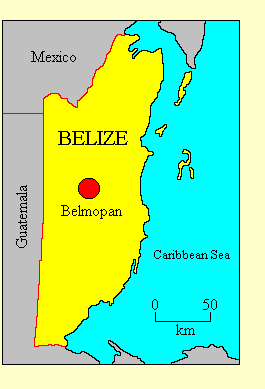
• Location: Central America
• International organisations: African, Caribbean and Pacific Group of States, Commonwealth of Nations,
Non-Aligned Movement, Organisation of American States, United Nations, World Trade Organisation
• Borders: Guatemala, Nexico
• Coastline: Caribbean Sea
• Land area: 22,966 Kmw
• Population: 320,000
• Annual GDP (PPP) per capita: US$8,100 (2009 CIA estimate). World ranking: 96
• Ethnicity: Most of the population are of Creole (mixed European, African and Native
American) descent. About 20% are of Mayan, Garifuna or other indigenous stock.
• Languages: English is the official language and the language of government and
business. About half the population speak an English creole called Kriol or Creola. About 30%
speak Spanish. Indigenous languages such as Garifuna, Mayan and Kekchi are spoken in the
interior.
• Religion: Christian 77% (Catholic 50%, Protestant 27%), other 14%
• Form of government: Constitutional monarchy and parliamentary democracy.
Belize is divided into six districts.
• Capital: Belmopan
• Constitution: The
Constitution of Belize came into effect on 21 September 1981.
• Head of state: Queen Elizabeth II, Queen of Belize. The Queen came to the British
throne on 6 February 1952, and has held the title Queen of Belize since 21 September 1981.
The Queen's functions in Belize are excercised by a Governor-General, appointed by the
Queen on the advice of the Prime Minister. The current Governor-General,
Sir Colville Young, took office on 17 November 1993.
• Head of government: The Prime Minister, appointed by the Governor-General. The Prime Minister is the
leader of the largest party in the legislature and is accountable to it.
• Legislature: Belize has a bicameral legislature, the National Assembly. The House of
Representatives has 29 members, elected for five-year terms from single-member
constituencies. The Senate has nine appointed members.
• Electoral authority: The Belize Elections and Boundaries Commission conducts national
elections.
• Freedom House 2011 rating: Political Rights 1, Civil Liberties 1
• Transparency International Corruption Index: no rating given
• Reporters Without Borders Press Freedom 2010 Index: no rating given
• Heritage Foundation Economic Freedom 2010 Index: 63.8% (71 of 178 countries rated)

Political history
The territory which is now Belize was officially part of Spanish central America from
the 16th century, but the Spanish did not settle the area. In the 18th century it was
occupied by English sailors, and on the strength of this it was annexed by the
British Governor of Jamaica in 1840. In 1862 it became the Crown Colony of British
Honduras.
Constitutional development began after the Second World War, and full internal
self-government was granted in 1964. But independence was delayed by Guatemala's
long-standing claim to the territory, based on rights inherited from Spain.
Britain agreed to guarantee Belize's territory from invasion, and independence
eventually came in 1981. Guatemala finally recognised Belize in 1992.
Since independence Belize's major political
parties have been the
social-democratic People's United Party (PUP) and the conservative United Democratic
Party (UDP). The PUP dominated Belize politics until 1984 - since then the two parties have alternated in power.
In February 2008 the UDP returned to office under Dean Barrow.
Freedom House's 2009 report on Belize
says: "Belize is an electoral democracy... Belize was ranked 109 out of 180 countries surveyed in Transparency
International's 2008 Corruption Perceptions Index... The judiciary is independent and nondiscriminatory, and the rule of
law is generally respected [but] Violent crime, money laundering, and drug trafficking continued unabated in 2008 due to
insufficient countermeasures and government corruption."
Updated October 2011
|