
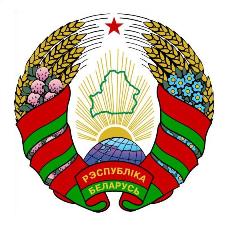
REPUBLIC OF BELARUS
• Official name: Respublika Belarus (Republic of Belarus). Until 1991 the country was usually called
Byelorussia in English. Both names mean White Russia in the Slavic languages.
• Location: Eastern Europe
• International organisations: Commonwealth of Independent States, Non-Aligned Movement, Organisation for
Security and Co-operation in Europe, United Nations
• Borders: Latvia, Lithuania, Poland, Russia, Ukraine
• Coastline: None
• Land area: 207,600 Km2
• Population: 9,700,000
• Annual GDP (PPP) per capita: US$11,600 (2009 CIA estimate). World ranking: 74
• Ethnicity: Belarusian 81.2%, Russian 11.4%, Polish, Ukrainian, and other 7.4%
• Languages: Most of the population speak either Belarusian or Russian or both. There is very little
difference between the two languages. Both are official languages.
• Religion: Nominal Orthodox Christian 80%, Catholic Christian 10%
• Form of government: In form, a presidential democratic republic. In practice, a dictatorship. Belarus
is divided into six regions and one municipality.
• Capital: Minsk
• Constitution: The
Constitution of the Republic of Belarus came into effect on 30 March 1994.
• Head of state: The President, elected by direct universal suffrage for a five-year term.
• Head of government: The Prime Minister, appointed by the President. In practice the Prime Minister is accountable to
the President.
• Legislature: Belarus has a bicameral legislature, the
National Assembly (Natsionalnoye Sabranie) has
two chambers. The House of Representatives (Palata Predstaviteley) has 110 members elected for four-year terms
from single-seat constituencies. The Council of the Republic (Soviet Respubliki) has 64 members, 56 members elected
indirectly and eight appointed by the President.
• Electoral authority: The Central Election Commission of Belarus conducts national elections.
• Freedom House 2011 rating: Political Rights 7, Civil Liberties 6
• Transparency International Corruption Index: 25% (127 of 178 countries rated)
• Reporters Without Borders Press Freedom 2010 Index: 43.0% (154 of 178 countries rated)
• Heritage Foundation Economic Freedom 2010 Index: 47.9% (155 of 178 countries rated)
Political history
The region now known as Belarus was incorporated into the
Russian Empire in the 18th century following the partitions of the Kingdom of Poland and Lithuania. A sense of a
separate Belarusian nationality emerged in the 19th century. When the Russian Empire collapsed in 1917, a
Belrusian People's Republic was declared in Minsk, but never successfully established itself as a state.
In 1921 Belarus was partitioned between Soviet Russia and Poland, and the Byelorussian Soviet Socialist Republic
became a republic of the Soviet Union. In 1939 Polish Belarus was incorporated into the USSR, but in 1941
the whole area was seized by the Germans, who murdered most of the large Jewish population of Belarus. In 1944 the Soviet
Union reoccupied Belarus.

When the Soviet Union was dissolved in 1991, Belarus, the most loyal of the Soviet republics, quite
unexpectedly found itself independent. An attempt was made to establish a democratic system, but the nationalist and
democratic forces in the
republic, such as the Belarusian Popular Front, were too weak to sustain it. In 1994 the maverick populist
Alexander Lukashenka was elected as Belarus's first president.
Lukashenka has established an authoritarian regime run along Soviet lines, and has a policy of re-uniting
Belarus and Russia, although no concrete steps have been taken in this direction. There is little press freedom and
Soviet-style repression is visited on opponents. Belarus is now the only country in Europe which cannot be
classified as even semi-democratic, and the only one in which the government is actively opposing movement
towards greater democracy and human rights.
Belarus has no real party system. President Lukashenka claims to be above party, and 90% of the members of
the legislature are "independents" who support the President. The Communist Party of Belarus and
the Agrarian Party of Belarus also support Lukashenka.
Freedom House's 2011 report on Belarus
says: "Belarusis not an electoral democracy. Serious and widespread irregularities have marred all recent elections, including
the December 2010 presidential poll... The constitution vests most power in the president, giving him control over the government,
courts, and even the legislative process by stating that presidential decrees have a higher legal force than ordinary legislation...
Opposition parties have no representation in the National Assembly, while pro-presidential parties serve only superficial functions...
Amendments to the electoral law adopted in 2009 give the parties more opportunities to campaign but do not provide for a transparent
vote count... Corruption is fed by the state’s dominance of the economy and the overall lack of transparency and accountability
in government... President Lukashenka systematically curtails press freedom. Libel is both a civil and a criminal offense,
and a 2008 media law gives the state a monopoly over information about political, social, and economic affairs.
Belarusian national television is completely under the control of the state and does not present alternative and opposition views...
Despite constitutional guarantees of religious equality, government decrees and registration requirements have increasingly
restricted religious activity... The government restricts freedom of assembly for critical independent groups...
Freedom of association is severely restricted... Although the constitution calls for judicial independence, courts are subject to
significant executive influence. The right to a fair trial is often not respected in cases with political overtones."
Updated October 2011
|